
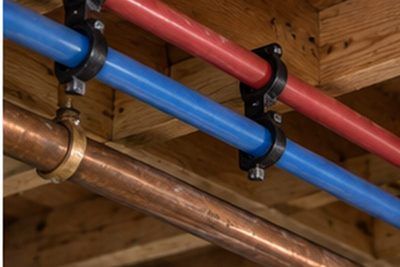
If you are repiping a pre-1960s Newark house, you are replacing galvanized steel that has been closing up from the inside for decades. That decision is usually easy by the time someone is asking about it.
The material question is the one that stalls people, and it gets debated as though it were about the pipe. It mostly is not.
The cost is not in the pipe
Here is the fact that reframes the whole comparison.
In a whole-house repipe of an occupied older home, the plumbing material is a minority of the bill. The majority is access and restoration — opening walls and ceilings to reach the runs, then putting them back.
So the question that decides cost is not "what does a foot of copper cost against a foot of PEX?" It is "how much wall has to come off?" — and that is where the two materials genuinely differ.
Why that hits harder in Newark's older housing
Pre-war and early post-war construction here is largely plaster and lath, not drywall.
Drywall is forgiving. Cut a channel, screw in a patch, tape, sand, paint, and a competent person cannot find it afterwards.
Plaster is not. It is a different trade, it cracks beyond the cut as you work, and horsehair plaster in a 1920s house tends to spread damage well past the opening. Patching it invisibly is skilled work, and matching an old textured ceiling frequently means skimming the whole surface rather than the patch.
That is the real argument for PEX, and it is an argument about carpentry and plastering rather than about plumbing.
Where the two materials actually differ
Flexibility, and therefore joints
Copper is rigid. Every change of direction is a soldered fitting, and a whole-house copper repipe involves dozens of them — many inside walls where you will never see them again.
PEX bends. A run can often be fished through existing cavities, around corners, and up from a basement into a bathroom with no joint at all between the manifold and the fixture.
Every joint is a potential leak in thirty years' time. A system with fewer concealed joints is a system with fewer places to fail where you cannot see it.
Topology: home-run versus trunk-and-branch
This is the functional difference nobody mentions, and it is the most interesting one.
Copper is practically installed as trunk and branch: a main line with tees off it to each fixture.
PEX makes a home-run manifold layout realistic — a central manifold with an individual small-diameter line to each fixture.
| Trunk and branch | Home-run manifold | |
|---|---|---|
| Shutting off one fixture | Isolate a section, or the house | One valve at the manifold |
| Hot water arrival time | Slower — larger pipe to purge | Faster — less water sitting in a smaller line |
| Pressure drop when another tap opens | Noticeable | Much less |
| Concealed joints | Many | Often none |
| Material used | Less total length | More total length |
The shower that goes cold when someone runs the kitchen tap is a trunk-and-branch symptom, and a manifold layout largely removes it.
Freeze behaviour
PEX has some capacity to expand as ice forms, so a run that would split rigid copper often survives. In a crawl space, an unheated garage, or an exterior wall — all common failure points around here — that is a genuine advantage.
It is not immunity. A hard enough freeze bursts PEX too, and the fittings do not flex regardless. Insulate exposed runs either way.
Where copper still wins
Copper is not the sentimental choice. There are specific places it is simply correct:
- Exposed to sunlight. PEX degrades under UV and manufacturers rate it for months of exposure, not years. Anything in daylight should be metal.
- At the water heater. Most PEX manufacturers require a short metallic section at the heater connection.
- High-temperature recirculation loops. Continuous hot circulation is the hardest duty in a domestic system, and copper does not care.
- Rodent exposure. Rodents will chew PEX, and in an old crawl space with a history of them, that is worth weighing.
- Already-open basements. Where the runs are exposed joists and nothing needs restoring, PEX's main advantage disappears and the comparison narrows to material and labour cost alone.
That last point is the honest one. In an unfinished basement, copper is much more competitive than the general advice suggests, because you are no longer paying to avoid demolition you were not going to do.
PEX-A or PEX-B
If PEX is the answer, there is a second choice inside it.
PEX-A uses expansion fittings: the pipe is expanded, the fitting inserted, and the pipe shrinks back onto it. The fitting does not restrict the bore, it is the most freeze-tolerant of the types, and a kink can be repaired with heat.
PEX-B uses crimp or clamp rings over an insert fitting, which slightly narrows the bore at each connection. It is less expensive and entirely code-compliant.
Both are fine. PEX-A is the better material and costs more; on a long run with few fittings the difference matters less than on a complicated one.
The polybutylene question
Worth addressing directly, because it comes up in every conversation about plastic pipe in housing of this era.
Polybutylene is the grey flexible pipe installed roughly between 1978 and 1995. It failed widely — largely at the plastic acetal fittings and through degradation by the disinfectants in treated water — and became the subject of a major class action. Insurers still treat it as a liability.
PEX is a different material. Cross-linked polyethylene, decades of European use, and a long mainstream record here.
If you find grey flexible supply pipe in a house built in that window, that is a real finding and worth acting on. It is also not an argument about PEX.
How to decide
| PEX is usually right when | Copper is worth considering when |
|---|---|
| The house is occupied during the work | The runs are already exposed and accessible |
| Walls are plaster and lath | Walls are drywall, or coming off anyway |
| Runs pass through crawl spaces or unheated areas | Any run will be exposed to daylight |
| You want individual fixture shutoffs | There is a high-temperature recirculation loop |
| Budget is a real constraint | You have a strong preference and the budget for it |
| Speed matters — occupied house, fewer days without water | Rodent activity is a known problem in the crawl space |
For most occupied older Newark homes the answer comes out PEX, and the reason is almost entirely the plaster. In an open basement, or where walls are already opening for other work, the honest answer is that either material will serve you well for longer than you will own the house.
What matters more than the material
Both fail the same way when installed badly, and these are the things to check in any quote:
- Is the whole house being done? Partial repiping of uniformly original steel produces a repeat in a few years, and you pay for access twice. The repiping page covers why.
- Are runs properly supported at the correct spacing? Unsupported PEX sags and hammers.
- Are protection plates fitted where pipe passes through studs and joists? A screw through a concealed pipe is a permanent regret.
- Are there accessible shutoffs at the manifold or on each branch?
- Is restoration in the quote, and to what standard? "Patched" and "finished to match" are very different numbers in a plaster house. Get it in writing.
- Is the permit included? Repiping is alteration work, not repair — see plumbing permits in Newark.
Item five is the one that produces disputes. In a plaster house, restoration standard is not a detail; it can be a large fraction of the job.
In short
The material argument is mostly a restoration argument. PEX bends, so it can be fished through existing cavities with far fewer concealed joints, and in a plaster-and-lath Newark house that avoided demolition is where the savings actually come from — not from the price of the pipe.
PEX also enables a home-run manifold layout, which gives individual fixture shutoffs and takes the sting out of a shower going cold when a tap opens elsewhere. It handles freezing better than copper without being freeze-proof.
Copper remains correct in daylight, at the water heater connection, on high-temperature recirculation, and anywhere rodents are a known problem — and it is far more competitive than the general advice suggests when the basement is already open.
And PEX is not polybutylene. Different material, different history. If you have found grey flexible pipe from the 1980s, that is a separate and more urgent conversation.
Related questions
No. They are different polymers with different failure histories, and the confusion costs PEX a lot of unearned suspicion.
Polybutylene is the grey — occasionally blue — flexible pipe installed roughly between 1978 and 1995, which became the subject of a major class action after widespread failures, largely at the plastic acetal fittings and from degradation by disinfectants. PEX is cross-linked polyethylene, a separate material with decades of use in Europe and now a long mainstream record in the US. If you find grey flexible pipe in a house of that era, that is a genuine finding worth acting on — but it is not PEX.
Better than copper, but it is not freeze-proof and nobody should sell it to you as such.
PEX can expand somewhat under the pressure of forming ice, so a run that would split a rigid copper pipe will often survive in PEX. That is a genuine advantage in a crawl space or an unheated garage. What it does not do is make insulation and winterising optional — a hard enough freeze still bursts PEX, and the fittings are rigid regardless of what the pipe does. See preventing frozen pipes.
PEX is a standard, code-recognised material and a correctly installed PEX system is not a defect. What an inspector will note is the same thing they note about any system: exposure to sunlight, missing protection plates, unsupported runs, or fittings in concealed locations.
In practice, a repiped house sells better than one with original galvanized steel regardless of which material replaced it. The finding that hurts a sale is corroded steel, not plastic.
Yes, and most repipes do. Transition fittings for the purpose are standard, and there are places where copper is the right answer inside a mostly-PEX system.
The water heater is the usual one: most PEX manufacturers require a short length of metallic pipe at the heater connection — commonly in the range of six to eighteen inches — with the exact figure set by the manufacturer's instructions and the adopted code. Exposed runs in daylight are another, because PEX does not tolerate prolonged UV.