
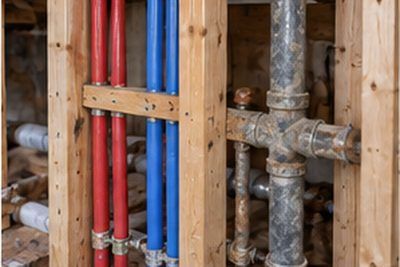
Why this is the Newark plumbing project
Most plumbing problems are events. A water heater fails, a drain blocks, a fitting gives up. Repiping is different: it is the end of a process that has been running quietly inside your walls since the house was built.
Newark's older neighbourhoods — the streets around Main Street, the housing serving the University of Delaware, and the pre-war and mid-century stock spread through the older parts of town — were plumbed in galvanized steel. It was the standard material of its era and there was nothing wrong with the choice. It simply has a service life, that life is 40 to 70 years, and virtually all of it here is now past the end of it.
What is actually happening inside the pipe
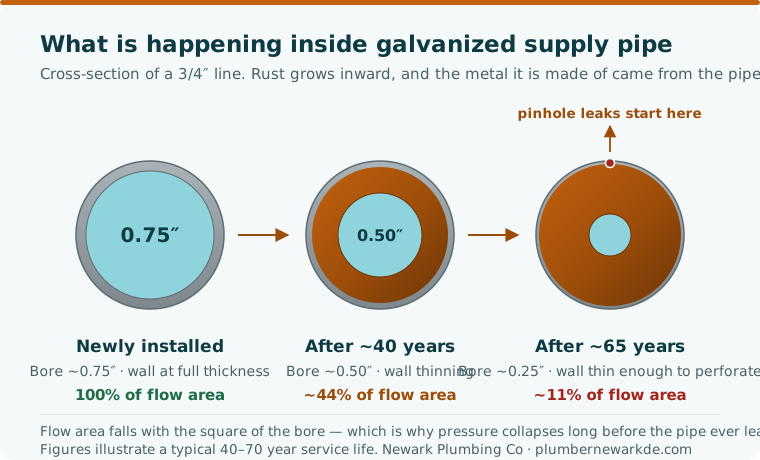
Galvanized steel is ordinary steel with a protective zinc coating. Water slowly strips the zinc. Once it is gone, the steel beneath begins to rust — and because the water is inside the pipe, the rust grows inward.
A pipe that started with a three-quarter inch bore can end up with a quarter inch of usable space, choked with a rough, layered deposit. Nothing reverses it. You cannot clean it out; the metal that formed the rust came from the pipe wall, so the wall is now correspondingly thinner.
Which produces a recognisable set of symptoms:
- Pressure that collapses when a second tap opens. The classic one. The restricted bore cannot supply two fixtures at once.
- Hot side noticeably worse than cold. Heat accelerates the corrosion, so hot runs usually degrade first.
- Rusty or brown water after the house has stood unused, clearing after a minute of running.
- Pinhole leaks arriving in clusters. The most important signal on this page. One pinhole is not bad luck — it is the first of several.
- Visible rust staining or bulging at threaded joints, where the wall is thinnest.
The clustered-pinhole rule
If you have had two pinhole leaks in different places within a couple of years, you are no longer making a repair decision — you are choosing between repiping on your schedule or repiping on the pipe's schedule. The second option costs more, because it includes water damage.
What the work involves
- Survey and plan the routes. We map every run and work out how to reach it with the fewest openings. This is where the money is saved or wasted, and it is worth taking time over.
- Protect and open access. Floors covered, furniture moved or sheeted, and small, deliberate openings cut where the route requires them.
- Run the new system. PEX or copper from the main through to every fixture, with proper support, correct sizing per fixture group, and new shutoff valves — which in an old house are frequently seized solid and worth replacing regardless.
- Rough-in inspection. The State Plumbing Inspector sees the new work before anything closes up. Walls stay open until it passes.
- Tie in, pressure test and flush. Every fixture tested under real simultaneous load, not one tap at a time.
- Close and patch. Openings closed and finished ready for paint. Agree in advance who is painting — that is a normal division of work, but it should be explicit rather than assumed.
A typical Newark repipe takes several days rather than weeks. Water is off during working hours and restored each evening in most cases, so the house remains liveable. We will tell you honestly if yours is an exception.
What drives the price
Repiping in this area runs roughly $6,000 to $18,000. The spread is real, and it is mostly not about the pipe.
- Number of bathrooms and fixture groups. The strongest single driver — each one is a set of runs.
- How many floors. Vertical runs between storeys are harder to reach than horizontal runs in a basement ceiling.
- Finished versus unfinished basement. An open basement ceiling can cut the access work dramatically. A finished one adds it back.
- Wall and ceiling construction. Plaster and lath — common in Newark's older housing — is more work to open and considerably more work to restore than drywall.
- Material choice. Copper costs more than PEX in both material and labour.
- How much restoration you want included. Patched and ready for paint is one price; finished and painted is another.
Two of those items interact, and it is the interaction that usually decides the material. PEX or copper for a repipe goes through it properly — joint count, the home-run manifold layout PEX makes possible, freeze behaviour, and why plaster and lath tilts the answer so far toward PEX in an occupied house.
The case for doing it before it fails
Repiping a house that has not yet flooded is a planned project on a schedule you choose, at a price you agreed in advance, with the furniture moved out of the way beforehand.
Repiping a house after a supply line lets go inside a wall is the same work plus water damage, plus drying, plus whatever the water reached on its way down, plus an insurance process that may treat gradual corrosion as a maintenance failure rather than a sudden event.
If you are not sure which stage your system is at, a leak and pressure assessment will tell you. And if you are buying an older Newark home, check the supply material before you close — alongside a sewer camera survey, it is the cheapest insurance available on a pre-1970 house.
Whole-Home Repiping in Newark — common questions
Find an exposed supply pipe — basement, crawl space, or under a sink. Galvanized steel is dull silver-grey, threaded at the joints, and magnetic. Copper is unmistakably copper-coloured and soldered. PEX is flexible plastic, usually red, blue or white. A fridge magnet settles it in seconds: it sticks firmly to galvanized steel and not at all to copper or plastic.
One caution. Many Newark homes have been partially repiped over the decades, so visible copper near the water heater does not mean the whole house is copper. The original steel often survives inside walls and under floors, which is exactly where it causes trouble.
Typically 40 to 70 years, and essentially all of Newark's original galvanized steel is now past that. The pipe does not wear out evenly — zinc coating depletes, then the steel beneath begins rusting inward, and the rust layer builds into the bore until the usable diameter is a fraction of what it started as.
The failure curve is not linear. Decades of gradual narrowing, then a period where pinhole leaks start appearing in quick succession. If you have had one pinhole, the others are already forming.
Both are good materials and we install either. PEX is flexible, which means far fewer joints and far less demolition, since it can often be routed through existing cavities rather than requiring walls to be opened along every run. It resists freeze damage better, costs less, and installs faster. Copper is rigid, proven over a much longer track record, tolerates high temperatures, and some owners simply prefer it.
For a full repipe of an occupied older Newark home, PEX is usually the better value — chiefly because it minimises the wall opening and restoration that dominate the cost. Where runs are already exposed in an open basement, the gap narrows considerably.
You can, and sometimes you should. If one branch is failing and the rest of the system is copper installed twenty years ago, replacing that branch is entirely sensible.
What rarely works is partial repiping of a house that is uniformly original galvanized steel. The remaining runs are the same age and in the same condition, so you get a repeat within a few years — and the second project costs more than the first would have, because you pay the access and restoration twice. If a plumber recommends doing half, ask what condition the other half is in and how they established it.
Yes. A whole-home repipe is substantial alteration of the plumbing system and requires a permit in Newark, with inspection by a State of Delaware Plumbing Inspector. Expect inspection at rough-in, while the new pipe is still visible and before anything is closed up.
That sequencing is worth understanding, because it shapes the schedule: walls stay open until the inspection passes. A contractor proposing to close up before rough-in inspection is either planning to skip the permit or planning to open it again.
What to Expect
How a service call actually goes
No mystery and no vague promise to take a look. Here is the sequence from the moment you dial.
-
You call and describe the problem
A person picks up and asks practical questions — where the water is, whether it is still running, whether you have found the shutoff. If it is an emergency, we walk you through isolating it before we are anywhere near your street.
-
We give you an arrival window
A real window, not sometime today. You get a call before we head over. If the schedule slips, you hear it from us instead of wondering.
-
Diagnosis first, price second, work third
We find the actual cause before quoting. You get the price for the repair in front of you, and what it covers, before any work starts. If the honest answer is that a repair will not hold and you need a replacement, we say so and explain why.
-
We finish, test, and clean up
The repair gets tested under real conditions before we pack up — pressure restored, drains run, no weeping joints. Drop cloths down, debris out, and a plain-language explanation of what failed and what to watch for.
That sequence is the whole of our method, and how we work and price jobs explains the reasoning behind it — including the jobs we will talk you out of.