
Most seasonal plumbing advice is a list of tips with no sequence and no deadline, which makes it easy to read and easy to not act on.
This is the same list arranged as a schedule, working backwards from the first hard freeze. In northern Delaware that usually lands some time in November, and it frequently arrives without much warning.
If you want the reasons behind any of this — why freeze-thaw cycling is harder on plumbing than sustained cold, and why the buried line is never the pipe that freezes — that is covered separately in how to prevent frozen pipes in a Newark winter. This page is the doing.
The schedule
| When | Task | Time |
|---|---|---|
| Early October | Disconnect and drain every hose bibb | 20 min |
| Early October | Shut down and blow out irrigation | Contractor |
| Early October | Clear gutters, check grading away from the foundation | 1–2 hrs |
| Mid October | Close crawl space vents, check the access door seals | 30 min |
| Mid October | Insulate exposed pipe runs | 1–2 hrs |
| Mid October | Test the sump pump and check the discharge line | 15 min |
| Late October | Find the main shutoff and confirm it turns | 10 min |
| Late October | Check water heater age, flush if due | 45 min |
| Late October | Replace any plastic supply connectors | 30 min |
| First frost warning | Open cabinet doors on exterior walls, set taps to drip | 5 min |
Nothing on that list is difficult. The whole thing is about four hours spread across three weekends, and it prevents the two calls we get most in a Newark winter.
Early October
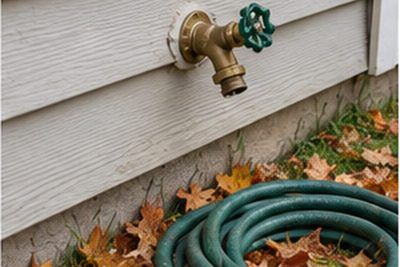
1. Hose bibbs — do this one first
The single most common winter failure in this area, and the cheapest to prevent.
- Find the shutoff valve inside for each outdoor tap, usually just inside the wall it passes through.
- Close it.
- Go outside and open the outdoor tap. Leave it open all winter so any water left in the line can expand harmlessly.
- Disconnect every hose. Coil and store them.
Frost-free bibbs still need the hose disconnected. The frost-free design works by drain-down when you close the valve, and a connected hose defeats that entirely. This catches people who believe they are already protected.
2. Irrigation systems
If you have in-ground irrigation, it needs shutting down and blowing out with compressed air. This is contractor work — a residential compressor will not shift the water and you can damage heads trying.
Book it in September if you can. Everyone books in the same fortnight.
3. Gutters and grading
Not strictly plumbing, but it lands on us in the spring.
Blocked gutters overflow against the foundation. Water pooling at the wall finds its way to the footing drains, which is how basements that were fine in October become wet in March. Clear the gutters and check that the ground slopes away from the house rather than toward it.
If your basement already takes water, the sump pump page covers why the ground here does that and what actually fixes it.
Mid October
4. Crawl space vents and the access door
Foundation vents exist for summer moisture control. Left open through winter, they turn a crawl space into outdoor air with your plumbing in it.
Close them. Then check the access door actually seals — a gap channels wind directly at the pipes, and moving air strips heat far faster than still air at the same temperature. A draughty crawl space is the most common location for a frozen pipe in this area.
5. Insulate what is genuinely exposed
Foam pipe sleeve is inexpensive and fits by hand. Prioritise, in this order:
- Anything in a crawl space, unheated garage or attic
- Runs on exterior walls
- The first few feet either side of where a pipe passes through an unheated space
Insulation slows heat loss; it does not add heat. On a genuinely exposed run in a hard freeze it may not be enough on its own — that is what thermostatically controlled heat cable is for, on a GFCI outlet.
6. Sump pump and discharge
Pour a bucket of water slowly into the pit. Watch the full cycle: float lifts, pump starts promptly, water clears, pump stops cleanly without chattering. Go outside and confirm water is actually leaving the discharge.
Then check the discharge line itself. In this climate the outlet can freeze, and a pump that starts against a solid plug of ice burns out or trips its breaker — leaving you with no pump at all during a thaw.
Make sure the line has enough fall to drain fully between cycles, and that the outlet is clear and well away from the foundation.
Late October
7. Find the main shutoff — and turn it
Do this in daylight while nothing is wrong. It takes ten minutes and it is the highest-value item on this list.
In most Newark houses with a basement, the main valve is on the wall facing the street, near where the service line enters and close to the meter. In slab-built homes and newer townhomes it is more often a utility closet, the garage, or near the water heater.
Then actually turn it. Valves that have not moved in twenty years seize, and discovering that at 2am with water running is its own emergency. If it will not close, that is worth fixing on an ordinary Tuesday.
While you are at it, check the stop valves under each toilet and sink turn too.
8. Water heater
Two checks:
- How old is it? The data plate carries the manufacture date. Over ten years, plan replacement rather than wait for a January failure. Water heaters do not fail conveniently.
- Flush if due. Sediment in the tank reduces usable capacity and makes the unit work harder. On City of Newark supply at moderate hardness this is less urgent than in hard-water regions; on a private well it matters considerably more.
9. Supply connectors
Look behind each toilet and at the washing machine. Braided stainless is what you want. Plastic connectors are common in builder fit-outs and are responsible for a startling share of household flood damage when they let go.
They cost a few dollars each and take minutes to swap. This is the cheapest insurance in the house.
When a frost warning lands
- Open cabinet doors under sinks on exterior walls so room heat reaches the pipes.
- Let vulnerable taps drip. A slow steady drip relieves the pressure that actually splits pipes — it does not need to be a stream. Choose the tap furthest from where water enters the house.
- Keep the heat on if you travel. No lower than about 55°F. A house left cold to save on heating is a very expensive saving.
If the house will be empty
Relevant across Newark given the student rental sector and anyone travelling for a stretch of winter.
For a week or two, heat on and taps dripping is usually enough. For a whole season, consider shutting the water off at the main and draining the system — and if you do, drain it properly rather than just closing the valve, because standing water in the pipes is exactly what freezes.
Landlords have a further consideration: whoever is in the house needs to know where the shutoff is. That and the other rental-specific items are covered in the Newark landlord plumbing guide.
In short
Hose bibbs in early October — drain them, open them, disconnect every hose, frost-free or not. Crawl space vents closed and insulation on exposed runs by mid-month. Main shutoff located and confirmed turning by late October, along with the water heater check and any plastic supply connectors replaced.
About four hours total, spread across three weekends. The alternative is the two calls we take most in a Newark winter: a split hose bibb discovered in spring, and a frozen crawl space run discovered at the thaw.
Related questions
Work backwards from the first hard freeze rather than from a calendar date. In northern Delaware that usually falls some time in November, but it varies year to year and the first one often arrives with little warning.
Practically: do the outdoor work in October while it is still pleasant, and have everything finished before the first frost warning. The single most time-critical task is draining the hose bibbs, because a connected hose guarantees a split on the first freezing night.
For a weekend, no — just leave the heat on at a reasonable setting. For a week or more in winter, it is worth considering, and for a whole season it is worth doing properly.
The rule of thumb is how long a leak could run undetected. A burst supply line for two days while you are at a wedding is a different event from the same burst running for three weeks. If you shut off, also drain the system rather than leaving standing water in the pipes.
No. A frost-free bibb works by placing the valve seat back inside the heated wall, so the section exposed to cold drains itself when you close it. A connected hose prevents that drain-down, water stays in the exposed section, and the frost-free design gives you no protection at all.
Disconnect every hose regardless of the type of tap. It is the cheapest item on this entire list.