
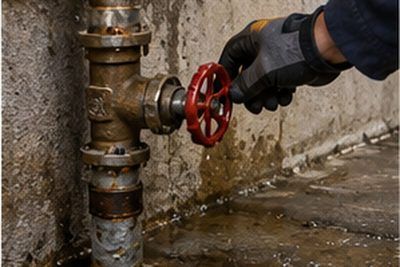
The first ninety seconds matter more than how fast we drive
Most of the damage in a plumbing emergency happens before anyone arrives. A half-inch supply line under pressure moves a surprising amount of water per minute, and the difference between a wet floor and a replaced ceiling is usually whether someone found the shutoff in the first two minutes.
So when you call us, the first thing we ask is not your address. It is whether the water is still moving, and whether you know where your main valve is. If you do not, we will find it with you over the phone. That conversation is free and it is worth more than anything we do after it.
Shut off first, in this order
- One fixture leaking? Close the small stop valve on the wall beneath it — clockwise.
- Anything bigger? Close the main shutoff. Basement wall facing the street in most Newark homes; utility closet or garage in newer construction.
- Water near electrics? Cut that circuit at the panel before you go near it.
- Water heater involved? Close its cold supply valve, and shut the gas or breaker to it.
What we treat as a genuine emergency
Plenty of companies will happily dispatch at 2am for a dripping tap, because after-hours rates are good business. We would rather keep the customer than win the call-out. These are the situations we consider actual emergencies:
- A burst or split supply line. Water under pressure, getting worse every minute.
- Sewage backing up into the house. A biohazard, and usually a main line failure rather than a fixture problem.
- No water at all. Frozen line, failed well pump, or a main break — each urgent for different reasons.
- Water reaching electrical equipment. Panels, outlets, or a furnace.
- A gas smell near plumbing appliances. Leave the building and call the gas utility first, then us.
- A shutoff valve that will not close. This is its own emergency, and it is always discovered at the worst moment.
Newark has two emergency seasons
This is not a generic observation — northern Delaware produces a very specific pattern, and it is driven by freeze-thaw cycling rather than deep cold.
The first hard freeze brings the hose bibb calls. An outdoor tap that was never shut off and drained splits internally, and the owner finds out weeks later when they open it in spring and water pours into the wall cavity instead. Buried service lines almost never freeze here, because New Castle County's 32-inch design frost depth means they sit well below the freeze line. What freezes is the exposed run: crawl spaces, unheated garage walls, and plumbing on an exterior wall of an older Newark house with little insulation behind it.
The first thaw brings the consequences. Ice that split a pipe is also plugging it. Nothing leaks while it stays frozen. Everything leaks at once when it does not. If you had a frozen pipe and it "fixed itself," you have a leak waiting for the thaw.
Older housing around Main Street and the University of Delaware adds a third, year-round category: galvanized supply lines that have corroded to the point where a single pinhole becomes a split. Those fail without warning and without a season. If your house is pre-1960 and still on original steel, read our page on whole-home repiping — the emergency you are trying to avoid is the one that starts there.
What happens when we arrive
Emergency work runs in a different order from scheduled work, because stopping the damage comes before understanding it.
- Isolate. If the water is not already off, that happens first — as far down the system as possible, so you keep water to the rest of the house.
- Establish what failed. A split pipe is obvious. Water appearing at a ceiling is not — it travels along joists and surfaces a long way from the source, which is why we locate before we cut.
- Make it safe and stable. Sometimes that is the permanent repair on the spot. Sometimes it is a sound temporary fix so you have water tonight and we do the proper job in daylight, with the right parts and a permit if one is required.
- Tell you what it costs before we do it. Emergency or not, you get the number first.
Why the cheapest emergency quote is usually the expensive one
Emergency pricing rewards shortcuts. A clamp on a corroded pipe is quick, cheap, and holds until it does not — which on badly degraded galvanized steel is often a matter of weeks, and the second failure usually happens somewhere you cannot see.
Where a repair genuinely will not hold, we will tell you that at the time, with the reason. You may still choose the temporary fix, and that is a legitimate decision at midnight. But you will make it knowing what you are buying.
For what non-emergency versions of this work cost, see our Newark plumbing price ranges. If the problem turns out to be a blocked main rather than a leak, drain and sewer clearing is the relevant page.
Emergency Plumbing in Newark — common questions
Four things genuinely cannot wait: water you cannot stop, sewage coming back up into the house, no water at all, and any leak near electrical panels or wiring. Everything else — a dripping tap, one slow drain, a running toilet, a water heater that has gone cold — is unpleasant but safe to leave until normal hours, and it will cost you less to handle then.
If you are not sure which you have, call and describe it. We would rather talk you through shutting a valve at 11pm than charge you for a call-out you did not need.
In most Newark houses with a basement, the main shutoff is on the wall facing the street, close to where the service line comes through the foundation, usually within a few feet of the water meter. In slab-built homes and newer townhomes it is more often in a utility closet, the garage, or near the water heater.
There is also a curb stop out at the property line under a small metal lid, but that one needs a key and is generally the water utility's to operate. Find your inside valve now, while nothing is wrong, and make sure it actually turns.
Yes, after-hours and holiday work carries a premium, and we state it on the phone before we dispatch rather than adding it to the invoice afterwards. A standard diagnostic visit in normal hours runs $75 to $150; emergency response is above that.
What we will also do is tell you when you do not need to pay it. If closing one valve makes your situation safe until morning, that is the advice you will get.
Shut the water off, then cut power to any circuit near the water. Move what you can out of the way and put towels down to steer water toward a drain rather than into a doorway. Photograph everything before you clean up — insurers want to see the damage as it happened.
Do not pour drain chemicals into a line that is already backing up. It will not clear the blockage, and it turns the standing water into something hazardous for whoever has to work in it.
What to Expect
How a service call actually goes
No mystery and no vague promise to take a look. Here is the sequence from the moment you dial.
-
You call and describe the problem
A person picks up and asks practical questions — where the water is, whether it is still running, whether you have found the shutoff. If it is an emergency, we walk you through isolating it before we are anywhere near your street.
-
We give you an arrival window
A real window, not sometime today. You get a call before we head over. If the schedule slips, you hear it from us instead of wondering.
-
Diagnosis first, price second, work third
We find the actual cause before quoting. You get the price for the repair in front of you, and what it covers, before any work starts. If the honest answer is that a repair will not hold and you need a replacement, we say so and explain why.
-
We finish, test, and clean up
The repair gets tested under real conditions before we pack up — pressure restored, drains run, no weeping joints. Drop cloths down, debris out, and a plain-language explanation of what failed and what to watch for.
That sequence is the whole of our method, and how we work and price jobs explains the reasoning behind it — including the jobs we will talk you out of.