
Emergency Plumbing
Burst pipes, active leaks, sewage backups and no-water situations, answered around the clock in Newark and New Castle County.
Emergency Plumbing detailsNewark, Delaware · New Castle County
Emergency repairs, drain cleaning, water heaters and sewer work across Newark and the surrounding New Castle County communities. We answer the phone 24 hours a day, 7 days a week, we diagnose before we quote, and we tell you plainly when a repair will hold and when it will not.
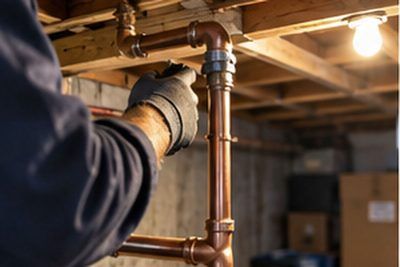
Local plumbing, properly understood
Most plumbing companies treat Newark as a single service area. It is not. Drive fifteen minutes in any direction from Main Street and the pipe in the ground changes, the water changes, and the failure you are about to have changes with it.
The older core — the streets around downtown and the University of Delaware — is largely pre-1960s housing running cast iron drains and galvanized steel supply. Both corrode from the inside. Both fail on a schedule you can almost predict by decade.
The newer developments east and south toward Bear, Glasgow and Middletown are PVC and copper on county sewer. Different material, different failure: builder-grade fixtures, pressure-reducing valves at end of life, and shortcuts that surface just after the warranty expires.
That is why we diagnose before quoting and why there are jobs we will talk you out of — a template cannot tell you which of these three houses you own.
North and west, toward Pike Creek and Hockessin, private wells and septic systems are still common. That is a different trade again — pressure tanks, submersible pumps, water treatment, and drain practice that will not destroy a septic field.
What we do
Residential and light commercial — water, waste and gas. Thirteen services, each one explaining what actually goes wrong before it explains what we charge.
Burst pipes, active leaks, sewage backups and no-water situations, answered around the clock in Newark and New Castle County.
Emergency Plumbing detailsCabling and hydro jetting for kitchen, bath, laundry and main line clogs — including the scale-choked cast iron common in older Newark homes.
Drain Cleaning detailsTank and tankless diagnosis, element and valve repair, and same-day replacement sized to your household's actual demand.
Water Heaters detailsCamera inspection, root cutting, spot repair and full lateral replacement for the clay and cast iron laterals under Newark's older streets.
Sewer Lines detailsAcoustic and thermal location of slab, wall and service-line leaks, so the repair opens one section of drywall instead of five.
Leak Detection detailsReplacing failing galvanized steel and corroded copper with PEX or copper — the defining plumbing project for Newark's pre-1960s housing stock.
Repiping detailsPrimary pumps, battery backups and discharge routing for basements sitting on northern Delaware's Piedmont clay and high water table.
Sump Pumps detailsSofteners, filtration, pressure tanks and submersible pumps for the private-well properties north and west of Newark.
Water Treatment & Wells detailsReplacing the buried supply line between the water main and your house, including lead and galvanized service lines in older Newark and Wilmington property.
Service Lines detailsNew appliance runs, gas line repair, pressure testing and leak location — permitted work inspected by a State of Delaware Plumbing Inspector.
Gas Lines detailsRunning toilets, weak flushes, rocking bowls and full replacements — including the odd rough-in spacings found in pre-war Newark bathrooms.
Toilets detailsAnnual testing, repair and replacement of backflow preventers on commercial premises, irrigation systems and fire lines across New Castle County.
Backflow detailsJammed units, dead motors and replacements — plus an honest answer about why we will not fit one on a septic system or an old cast iron drain.
Disposals detailsHow we work
A person answers and asks the questions that matter — where the water is, whether it is still moving, whether you have found the shutoff.
Not "sometime today." You get a real window and a call before we set off.
Cause first, fixed price second, work third. You approve the number before a tool comes out.
Pressure restored, drains run, joints dry. Drop cloths down, debris gone, and a plain explanation of what failed.
Why homeowners call us back
24 hours a day, 7 days a week. Not an answering service that takes a message and calls you back tomorrow.
We find the cause before quoting a fix. A number given before the diagnosis is a guess, and guesses get revised upward.
If a patch will not hold on a corroded line, we tell you, and we explain why. A repair sold twice is worse than a replacement sold once.
Newark permits go to a State Plumbing Inspector. Frost depth here is 32 inches. Half the county is on wells. These details change the work.
What to Expect
No mystery and no vague promise to take a look. Here is the sequence from the moment you dial.
A person picks up and asks practical questions — where the water is, whether it is still running, whether you have found the shutoff. If it is an emergency, we walk you through isolating it before we are anywhere near your street.
A real window, not sometime today. You get a call before we head over. If the schedule slips, you hear it from us instead of wondering.
We find the actual cause before quoting. You get the price for the repair in front of you, and what it covers, before any work starts. If the honest answer is that a repair will not hold and you need a replacement, we say so and explain why.
The repair gets tested under real conditions before we pack up — pressure restored, drains run, no weeping joints. Drop cloths down, debris out, and a plain-language explanation of what failed and what to watch for.
That sequence is the whole of our method, and how we work and price jobs explains the reasoning behind it — including the jobs we will talk you out of.
Where we work
From the Main Street core out through New Castle County, and across the line into Cecil County, Maryland.
Late-1990s and 2000s subdivisions east of Newark along US-40, on county sewer with PVC laterals.
Bear detailsThe DE-896 and US-40 corridor, mixing older ranch stock with newer townhome development.
Glasgow detailsThe Christiana Mall and ChristianaCare corridor — dense commercial alongside established residential.
Christiana detailsEstablished 1970s–1980s neighborhoods on rolling Piedmont ground north of Newark.
Pike Creek detailsLarger lots near the Pennsylvania line where private wells and septic systems remain common.
Hockessin detailsDelaware's largest city — the oldest and most challenging housing stock in the service area.
Wilmington detailsOne of Delaware's fastest-growing towns, dominated by new-build subdivisions.
Middletown detailsCecil County, Maryland — a short run down Elkton Road but a different regulatory world.
Elkton detailsWhy Newark plumbing fails when it does
Newark sits on the boundary between the Piedmont and the Atlantic Coastal Plain. North and west of town the ground is shallow soil over rock; south and east it turns to deeper sediment. That line runs more or less through the city, and it is why two houses four miles apart can have completely different basement water behaviour.
Layer northern Delaware's winter on top. We do not get sustained deep freezes so much as repeated freeze-thaw cycles — the pattern that is hardest on plumbing. Water expands in a pipe, relaxes, expands again. Joints that survived one hard night fail on the fifteenth cycle.
The practical consequence: the two busiest emergency periods here are the first hard freeze of the season, when hose bibbs that were never drained split, and the first thaw, when the damage from that freeze finally shows itself as water on a floor.
Common manufacturers in Newark-area homes. We are not a dealer for any single brand, which means the recommendation you get is based on the job, not on a quota.
Straight answers
Most Newark plumbing repairs fall between $150 and $600, with the diagnostic visit itself typically $75 to $150. A straightforward drain clearing sits at the low end; a water heater replacement or sewer lateral repair runs well above it. The honest answer is that no plumber can quote your job accurately over the phone, because the price depends on what is actually behind the wall. We diagnose first, then give you a fixed price before any work starts.
Yes, for most work beyond simple fixture swaps. Newark requires a plumbing permit for new installations, alterations and replacements, and the work must be inspected by a State of Delaware Plumbing Inspector rather than a city inspector. Delaware also allows a homeowner to do plumbing in a home they personally occupy, but the permit and the state inspection are still mandatory. You can reach Newark Code Enforcement at (302) 366-7000.
Yes. Delaware licenses plumbers through the Board of Plumbing, Heating, Ventilation, Air Conditioning and Refrigeration Examiners, and a Master Plumber licence is required to perform and supervise plumbing work. Delaware is stricter than many states here — it requires the Master Plumber exam specifically. Before hiring anyone in Newark, ask for their Delaware licence number and verify it with the Division of Professional Regulation.
In Newark housing built before roughly 1960, low pressure is usually galvanized steel supply pipe corroding from the inside. Galvanized pipe rusts inward over decades until the usable diameter shrinks to a fraction of the original, and no amount of cleaning reverses it. The telltale signs are pressure that drops sharply when a second tap opens, rusty water after the house sits unused, and hot side worse than cold. The fix is repiping the affected runs in PEX or copper.
New Castle County building code sets the design frost depth at 32 inches, and buried water lines are run below that — commonly around 42 to 48 inches — so they sit under the freeze line with margin. This is why a pipe that freezes in a Newark winter is almost never the buried service line. It is far more often an exposed run in an unheated crawl space, an uninsulated garage wall, or a hose bibb that was not shut off and drained before the first hard freeze.
Shut off the water before you call anyone. For a single fixture, close the stop valve underneath it. For anything larger, close the main shutoff — in most Newark homes it is on the basement wall facing the street, where the service line enters. If the leak is near electrical panels or outlets, cut power to that circuit as well. Once the water has stopped, the situation is no longer getting worse and you can call without panic.
Newark and New Castle County
Shut the water off first, then call. We will tell you honestly whether this needs someone tonight or whether it can wait until morning.
24 hours a day, 7 days a week