
Most homeowners discover the permit question halfway through a project, usually because a contractor mentioned it in passing or because something on a neighbour's job went wrong. It is worth understanding before you start, because the sequencing affects your schedule in ways people do not anticipate.
The part that surprises everyone
In most American cities, the municipality issues the permit and a municipal inspector inspects the work. Newark is not arranged that way.
Newark Code Enforcement issues the plumbing permit. A State of Delaware Plumbing Inspector inspects the work.
Delaware adopts the International Plumbing Code as the basis for its state plumbing code, and inspection authority sits at state level. The city handles the paperwork; the state signs off the pipe.
This trips up two groups regularly. Homeowners assume they are dealing with one office and are confused when scheduling runs through another. And contractors who work mainly in surrounding jurisdictions — including just across the line in Maryland — sometimes book the wrong inspection entirely and lose a week.
If you are hiring, this is a useful question to ask: who inspects this, and have you scheduled with them before? A plumber who works here regularly will answer immediately.
What needs a permit
The general principle is that new installation, alteration and replacement need a permit, while repair and like-for-like maintenance generally do not. In practice:
Generally requires a permit
- Water heater replacement, tank or tankless
- Repiping, whole-home or a significant portion
- Sewer lateral repair or replacement
- New fixtures where none existed — adding a bathroom, a wet bar, a basement toilet
- Relocating existing fixtures
- Gas line work of any kind
- Water service line replacement
- Backflow prevention device installation
- Anything involving drainage, waste or vent configuration
Generally does not
- Swapping a tap or a showerhead
- Replacing a toilet in the same location with the same connections
- Clearing a blockage
- Replacing a section of pipe with identical pipe in the same run
- Fixing a leaking trap or supply connector
The line sits roughly where "putting it back as it was" ends and "changing the system" begins. Water heater replacement often surprises people by falling on the permit side, but it involves gas connection, venting, and a temperature and pressure relief valve — all genuine safety items.
Confirm your specific job with Newark Code Enforcement on (302) 366-7000 rather than relying on this list. Requirements change, and the only answer that matters for your project is the current one.
Why rough-in inspection governs your schedule
This is the practical consequence that affects everyone doing concealed work.
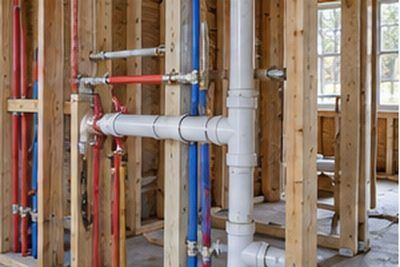
Inspection happens in stages, and the important one is rough-in — the inspector sees the new pipe while it is still exposed, before insulation, drywall or finishes go back. That is the only opportunity to verify what is behind the wall.
So on any job involving concealed pipe, the sequence is fixed:
- Permit issued
- New work installed, left exposed
- Rough-in inspection scheduled and passed
- Only then walls closed
- Final inspection where applicable
Walls stay open until rough-in passes. On a whole-home repipe that can mean living with open sections for longer than you expected, and it is not the contractor being slow.
A contractor proposing to close up before rough-in is telling you one of two things: they are not pulling a permit, or they are planning to reopen the wall. Neither is what you want.
What unpermitted work actually costs
The temptation is obvious — permits add time and a fee, and skipping them makes a quote look better. Here is what it defers rather than avoids.
It surfaces when you sell
Buyer's inspections and title searches routinely turn up work that has no permit record. At that point you are negotiating from the weakest position you will ever be in: under contract, with a closing date, and a buyer who now has leverage.
Common outcomes are a price reduction, a demand to permit the work retroactively, or a demand to redo it. Lenders sometimes decline to close until it is resolved.
Retroactive permitting is worse than doing it properly
An inspector still has to see the work. If it is behind finished walls, that means opening them again — so you pay for the original job, the demolition, the inspection and the restoration, rather than just the original job plus a fee.
Insurance may decline the claim
If unpermitted plumbing causes water damage, a carrier may deny the claim on the basis that the work did not meet code requirements. The saving evaporates against a single incident.
The safety items are the ones people skip
Permitted inspection checks specific things, and they are not arbitrary:
- Venting on gas water heaters. Improper venting is a carbon monoxide risk.
- Temperature and pressure relief valves and their discharge piping. A wrongly fitted T&P valve on a water heater is genuinely dangerous.
- Backflow prevention. Stops contaminated water reaching the public supply.
- Drain, waste and vent configuration. Wrong venting means traps siphon dry and sewer gas enters the house.
These are precisely the items an unlicensed or hurried installer is most likely to get wrong, and they are exactly what inspection exists to catch.
Homeowners doing their own work
Delaware allows you to do plumbing in the home you personally occupy without a licence. The permit and state inspection still apply.
Read the scope carefully: the home you occupy. It does not cover rental property you own, and it does not cover a house you are renovating to sell. Those need a licensed plumber.
If you are doing your own work, pull the permit. The inspection is a free second opinion on something that can flood your house, and it protects your position when you eventually sell.
Licensing, and the question to ask
Delaware licenses plumbers through the Board of Plumbing, Heating, Ventilation, Air Conditioning and Refrigeration Examiners, and a Master Plumber licence is required to perform and supervise plumbing work. Delaware is stricter than several neighbouring states — it requires the Master Plumber examination specifically.
Before hiring anyone, ask for the Delaware licence number and verify it with the Division of Professional Regulation. It takes a few minutes.
And if your property is across the line in Elkton or Cecil County, Maryland, none of the above applies. Different code, different permit authority, different licensing board. A Delaware licence does not automatically authorise work in Maryland.
The short version
Newark issues the permit; Delaware inspects the work. New installation, alteration and replacement generally need one — repair generally does not. Rough-in inspection happens before walls close, which sets your schedule. Homeowners can do their own work in their own home, but still need the permit.
And skipping it does not save money. It defers the cost to the moment you are least able to negotiate.
Related questions
Yes, in a home you personally occupy. Delaware permits homeowners to perform plumbing work on their own residence — but the permit requirement and the state inspection still apply in full. Doing the work yourself exempts you from needing a licence, not from the permitting process.
Note the wording: the home you occupy. It does not extend to rental property you own, and it does not extend to a house you are renovating to sell. Those are covered work requiring a licensed plumber.
It usually surfaces during the buyer's inspection or the title search, and it becomes a negotiating problem at the worst possible moment. Buyers commonly ask for the work to be permitted retroactively, for a price reduction, or for the work to be redone — and lenders sometimes refuse to close until it is resolved.
Retroactive permitting is possible but more expensive and more disruptive than doing it correctly the first time, because an inspector has to see concealed work that is now behind finished walls. That can mean opening them again.
The permit itself is generally issued quickly for straightforward residential work. The variable that matters more is inspection scheduling, because Delaware plumbing inspections run through the state rather than the city, on the state inspector's calendar.
Plan for it rather than around it. Rough-in inspection has to happen while pipe is still exposed, so walls stay open until it passes. Any contractor who proposes closing up before rough-in either intends to skip the permit or intends to open it again. Newark Code Enforcement can confirm current timelines on (302) 366-7000.