
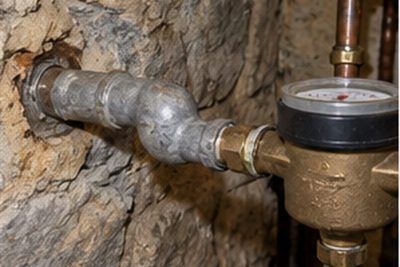
If your house in Newark or Wilmington was built before about 1940, the pipe bringing water in from the street may be lead. That has been true for decades. What changed recently is that the rules now put a date on doing something about it — and require your water supplier to tell you where you stand.
What the rule actually says
The EPA published the Lead and Copper Rule Improvements on 30 October 2024. Three parts matter to a homeowner.
Inventories and notification. Water systems had to submit initial service line inventories by October 2024 and notify customers whose line is lead, galvanized requiring replacement, or of unknown material. If you own an older property, you may already have had that letter.
Planning deadline. By 1 November 2027, systems must have baseline inventories, lead service line replacement plans, a list of schools and childcare facilities they serve, and updated sampling plans.
Replacement deadline. All lead service lines, and certain galvanized lines, must be replaced by 31 December 2037.
The rule also lowers the lead action level and tightens sampling methods, which is a technical change for suppliers rather than something a homeowner acts on.
One honest caveat
This rule is being litigated. American Water Works Association v. EPA challenges the feasibility of the replacement requirement; briefing is complete and oral argument was expected in autumn 2026. The rule remains in effect while that runs its course, but deadlines in this area have moved before. Check current status with your supplier or the EPA rather than relying on any article, including this one.
The thirty-second test
You do not have to wait to be told. Find where the water line enters your building — usually the basement wall facing the street, on the street side of the meter.
- Scratch it with a coin. Lead goes bright silver and is soft enough that the coin marks it easily. Galvanized steel stays dull grey and resists.
- Hold a magnet to it. Lead is not magnetic. Galvanized steel grips firmly. Copper does neither and is obvious by colour.
Bright silver scratch, no magnetic grip: treat it as lead.
Do not sand it, wire-brush it, or otherwise work at it to get a better look. Disturbing a lead line releases particles into the water. A coin scratch is enough.
One thing worth knowing: the pipe you can see inside the basement is not necessarily the whole story. Lines have been partially replaced over the decades, so a copper stub inside the wall can be connected to lead outside it. Your supplier's inventory record is better evidence than what is visible at the meter.
"Unknown" is not "fine"
When you contact your supplier and ask what their inventory shows for your address, a common answer is unknown.
That is a real category in the rule, not an evasion. Systems frequently have no record of what material was installed on the private side of older connections, because nobody wrote it down. Unknown lines are treated as lead for planning purposes until proven otherwise.
If your address comes back unknown, that is worth resolving rather than filing away. Some suppliers will inspect; some accept homeowner-submitted photographs; some schedule verification as part of their replacement programme.
Who pays for what
Responsibility for a water service line typically splits at the curb stop — the small valve under a metal lid near the property boundary. The utility is generally responsible up to that point, and the property owner from there into the building.
That boundary does vary between the City of Newark, Artesian, Veolia and the other suppliers in this area, so confirm it for your specific address rather than assuming.
What has changed is the direction of travel on the private side. Because replacing only half a lead line can temporarily make water quality worse, the rule pushes systems toward full replacement. Many programmes now cover or subsidise the homeowner's portion.
Ask specifically what your supplier's programme covers before assuming the bill is yours. The answer is often better than people expect, and it is the single most useful phone call in this article.
If work is happening on your street
Utilities replace lines in blocks rather than one at a time, so the cheapest moment to replace yours is when the crew is already there.
If you see main replacement work on your street and you have or may have a lead line, contact the supplier immediately rather than waiting for a letter. Coordinating your private side with their public side avoids paying twice for excavation and avoids leaving a partially replaced line in the ground.
If you are having the private side done independently, our page on water service line replacement covers how the work is done — directional boring versus open-cut trenching, and why what sits on top of the route drives most of the cost.
What to do meanwhile
Replacement is the fix. Until then:
- Filter for drinking and cooking. Use a filter certified for lead reduction and replace cartridges on schedule. An exhausted filter is worse than none, because it produces false confidence.
- Run the tap before drinking if water has been standing for several hours.
- Use cold water for drinking, cooking, and especially for making up infant formula. Hot water dissolves lead more readily. Never use hot tap water for formula.
- Clean aerators periodically. Particles collect in them.
- Test rather than assume. Your supplier can usually point you to a certified laboratory.
Which Delaware housing this affects
Lead service lines are a function of when the connection was made, not the style of the house.
Wilmington carries the oldest housing stock in our service area, with substantial pre-1940 row home construction — the window in which lead was standard. The same page covers the party-wall and shared-stack issues that come with that housing.
Newark's older core, around Main Street and the streets serving the University of Delaware, is the next most likely. Much of it is pre-1960s, and while the interior supply in that housing is usually galvanized steel rather than lead, the service line is a separate question with a separate answer.
Newer development toward Bear, Glasgow and Middletown is not affected. Those connections were made long after lead was discontinued.
Galvanized service lines get caught by the rule too, in a specific circumstance: where a galvanized line is or was downstream of a lead line, it can hold lead particles in its corrosion layer. That is the "galvanized requiring replacement" category, and it is why some owners with no lead pipe at all still appear on a replacement list.
In short
Your supplier has already been required to inventory service lines and notify customers whose line is lead, galvanized requiring replacement, or unknown. Baseline inventories and replacement plans are due 1 November 2027, and replacement must be complete by 31 December 2037 — subject to litigation that is still running.
Do the scratch-and-magnet test today, then ask your supplier what their inventory shows for your address. If the answer is "unknown", push for verification. And ask what their programme covers on the private side before assuming you are paying for all of it.
Related questions
Find where the water line enters the building, usually at the basement wall on the street side of the meter. Then two tests. Scratch it with a coin — lead scratches to a bright silver and is noticeably soft, while galvanized steel stays dull grey. Then hold a magnet to it — lead is not magnetic, galvanized steel grips firmly, and copper is obvious by colour.
Bright silver scratch plus no magnetic grip means treat it as lead until proven otherwise. Do not sand, file, wire-brush or otherwise disturb a suspected lead line — that releases particles into the water. Note what you found and contact your supplier.
Probably, yes. Water systems were required to submit initial service line inventories by October 2024 and to notify customers whose service line is lead, galvanized requiring replacement, or of unknown material.
If you do not recall receiving anything, that does not mean your line is fine — notices get missed, and properties change hands. Contact your supplier directly and ask what their inventory records for your address. "Unknown" is a common answer and is not the same as "not lead".
It depends on which portion and on your supplier's programme. Responsibility for the line typically splits at the curb stop, with the utility responsible up to that point and the property owner responsible from there into the building.
The EPA rule pushes systems toward replacing full lines rather than only their own portion, because replacing half a lead line can make water quality worse in the short term. Many programmes now cover or subsidise the private side. Ask specifically what your supplier's programme covers before assuming the whole bill is yours.
Generally no, and this is worth knowing before anyone offers you one. Replacing only part of a lead service line can disturb the remaining pipe and temporarily increase lead release rather than reduce it.
The current regulatory direction is full replacement for exactly this reason. If work is being done on your street and only the utility-side portion is being replaced, ask what is planned for the private side and over what timeframe, rather than leaving a half-replaced line in place indefinitely.
Use a filter certified for lead reduction on any tap used for drinking or cooking, and maintain it on schedule — an exhausted filter is worse than none because it gives false confidence. Run the tap before drinking if water has been sitting for hours. Use cold water for drinking, cooking and especially for making up infant formula, because hot water dissolves lead more readily.
Clean tap aerators periodically, since particles collect there. And have the water tested rather than guessing — your supplier can usually direct you to a certified laboratory.