
Two different jobs, and most of the money is in the first one
People call a plumber to fix a leak. But a concealed leak is really two pieces of work — finding it, then repairing it — and the finding is where the cost of the whole project is decided.
The repair itself is often modest. A failed joint or a pinhole in a copper line is straightforward once it is in front of you. What makes a concealed leak expensive is access: cutting into walls, ceilings or concrete, then putting them back. Locate precisely and that is one opening. Guess, and it is several, because water does not surface where it originates.
Water runs along joists, follows pipe runs, travels across the top of a ceiling and drops through at whatever the lowest point happens to be. A wet patch on a ceiling routinely sits several feet from the actual failure. Opening the wet spot is the intuitive move and it is frequently the wrong one.
Do the meter test before you call anyone
Five minutes, no tools
- Turn off every tap, appliance and ice maker in the house.
- Find your water meter and note the reading, or watch the small low-flow dial.
- Leave it two hours with nothing drawing water.
- Read it again.
Movement means water is leaving the system somewhere. That single fact changes the conversation completely — it rules out condensation, spillage and every other explanation, and tells us to start looking rather than start debating.
If you are on a private well rather than city supply, you have no meter — but you have something nearly as useful. A pump that kicks on when no one is using water is telling you the same thing. That is covered on our well systems page.
How we locate without opening anything
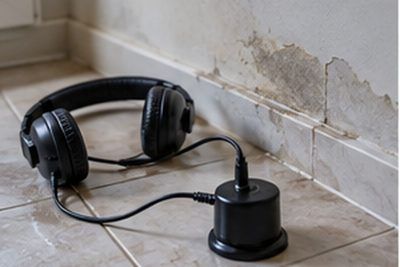
- Acoustic detection. Pressurised water escaping a pipe makes a distinctive sound. Ground microphones and amplified listening discs pick it up through floors, walls and soil, and the point where it is loudest is the leak. This is the primary method for pressurised supply lines.
- Thermal imaging. A hot water leak warms the material around it; a cold one cools it. An infrared camera makes that visible as a pattern and is particularly effective through drywall and under flooring.
- Pressure isolation. Sectioning the system and testing each branch separately narrows the search to one run before finer methods start. Unglamorous, and often the fastest route.
- Tracer gas. For stubborn or very small leaks, an inert gas introduced into the line escapes at the failure and is picked up at the surface by a detector. Works where acoustic methods struggle, such as very low pressure or noisy environments.
- Moisture mapping. Meters read moisture content through building materials, tracing the wet area back toward its source rather than its destination.
Where Newark leaks tend to be
The housing stock predicts the failure. Around the older core near Main Street and the University of Delaware, the most common concealed leak is a pinhole in corroded galvanized steel supply — and a pinhole in badly degraded steel is rarely a one-off. It is the first visible symptom of a system approaching the end of its life, which is why we will tell you honestly if the sensible answer is repiping rather than a patch.
In mid-century housing, failed solder joints in copper and dielectric corrosion where copper meets steel are frequent. In newer construction toward Bear, Glasgow and Middletown, leaks cluster at fittings and connections rather than in the pipe itself — builder-grade supply lines to toilets and washing machines are a recurring culprit.
Seasonally, the local pattern is distinct. New Castle County's 32-inch design frost depth means buried service lines sit well below the freeze line, so the leaks that appear after a cold snap are nearly always from exposed runs in crawl spaces, unheated garages and outside walls. And the damage from a winter freeze frequently does not present as a leak until the thaw, because the ice that split the pipe is also sealing it.
What you get from us
A specific location, marked. The likely cause. Photographs and thermal images where relevant. A repair price with the access and restoration work identified separately, so you can see what you are paying for rather than receiving one number with no breakdown.
And where the honest answer is that the leak we found is a symptom of a system that needs replacing, you will hear that too — with the evidence, so you can judge it yourself.
Detection runs $150 to $500; accessible pipe repairs $200 to $800; concealed or slab repairs $600 to $2,500. See the full ranges. If water is actively running right now, shut it off and treat it as an emergency.
Water Leak Detection & Pipe Repair in Newark — common questions
The meter test settles it. Turn off every water-using fixture and appliance in the house, then look at your water meter and note the reading or watch the low-flow indicator. Wait two hours with nothing running. If the reading has moved, water is going somewhere.
Other signals worth acting on: a bill that has climbed with no change in habits, a warm patch on a floor, a musty smell with no visible source, a section of lawn that stays green through a dry spell, or a water heater or well pump cycling when nothing is in use.
A persistently warm patch on a floor is one of the more reliable slab leak indicators, because it usually means the hot water line beneath is leaking and heating the concrete above it. It is worth acting on quickly — a hot side slab leak wastes both water and the energy used to heat it.
That said, slab construction is less universal around Newark than in parts of the country where slab leaks dominate. Plenty of housing here has basements and crawl spaces, which means a warm floor may instead be a leak in the space below. Either way the diagnosis is the same: find it precisely before opening anything.
Leak detection in Newark generally runs $150 to $500 depending on the size of the property and how difficult the leak is to isolate. The repair is priced separately once we know what we are dealing with.
It is worth separating the two in your head. Paying for detection feels like paying for nothing, because you end the visit with the same leak you started with. What you have actually bought is the difference between opening one wall and opening five — and on concealed or slab repairs, access and restoration are usually the larger share of the bill.
Homeowner policies commonly cover sudden and accidental water damage while excluding the failed component itself, and they very often exclude damage from a leak that has been seeping gradually over a long period. The practical consequence is that finding a slow leak early is worth more than finding it late, in insurance terms as well as repair terms.
Photograph everything before any remediation starts, keep the detection report, and notify your insurer before work begins rather than afterwards. We are plumbers rather than adjusters — check your specific policy wording.
What to Expect
How a service call actually goes
No mystery and no vague promise to take a look. Here is the sequence from the moment you dial.
-
You call and describe the problem
A person picks up and asks practical questions — where the water is, whether it is still running, whether you have found the shutoff. If it is an emergency, we walk you through isolating it before we are anywhere near your street.
-
We give you an arrival window
A real window, not sometime today. You get a call before we head over. If the schedule slips, you hear it from us instead of wondering.
-
Diagnosis first, price second, work third
We find the actual cause before quoting. You get the price for the repair in front of you, and what it covers, before any work starts. If the honest answer is that a repair will not hold and you need a replacement, we say so and explain why.
-
We finish, test, and clean up
The repair gets tested under real conditions before we pack up — pressure restored, drains run, no weeping joints. Drop cloths down, debris out, and a plain-language explanation of what failed and what to watch for.
That sequence is the whole of our method, and how we work and price jobs explains the reasoning behind it — including the jobs we will talk you out of.