
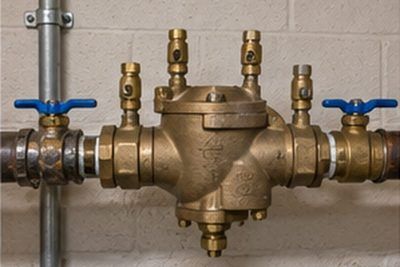
What it actually prevents
Water in a public main is meant to travel one way. A backflow preventer stops it travelling the other way — from inside a building back into the supply that feeds everyone else on the street.
That reversal happens two ways, and both are ordinary rather than exotic:
- Back-siphonage. Pressure in the main drops — a burst nearby, a hydrant opened for firefighting, a repair — and the resulting suction pulls water backwards out of connected systems.
- Back-pressure. A system inside the building runs at higher pressure than the main, typically a boiler loop or a pump, and pushes its water back toward the supply.
Neither requires anything unusual to go wrong. That is exactly why suppliers require the device rather than trusting the arrangement.
Who needs one around Newark
Our Christiana corridor work is where this concentrates — the mall and hospital area carries restaurants, medical offices, retail and hotels, and nearly all of them have a testing obligation.
| Premises or system | Why it needs protection |
|---|---|
| Food service | Chemical cleaning, carbonation equipment, dishwashers |
| Medical and dental | Suction equipment and chemical handling |
| Fire suppression lines | Stagnant water, sometimes with additives |
| Boiler and chilled water loops | Treatment chemicals, and back-pressure |
| Irrigation systems | Heads sitting in standing water and fertiliser |
| Car washes and laundries | Detergents and recycled water |
| Any premises with a booster pump | Creates back-pressure by design |
Residential properties usually need nothing at the meter. The common exception is an in-ground irrigation system, which is a textbook cross-connection.
The responsibility trap
Tenants are frequently liable without knowing it
The testing obligation commonly follows the water account, not the lease boundary. If the water bill is in your business name, the supplier will write to you — even when the device is landlord-installed building equipment you have never seen.
Check the lease. Then check whose name is on the water account. If those two answers disagree, settle it in writing before a notice arrives rather than afterwards.
The three device types you will encounter
- RPZ — reduced pressure zone. The highest level of protection and what high-hazard premises require. Two check valves with a relief valve between them that discharges if either fails. Needs a drain and cannot be installed in a pit.
- DCVA — double check valve assembly. Two check valves in series. Used on lower-hazard connections, commonly fire lines.
- PVB — pressure vacuum breaker. Typical on irrigation. Protects against back-siphonage but not back-pressure, so it must sit above the highest sprinkler head.
Which one your premises requires is set by hazard level, not preference. Fitting a DCVA where an RPZ is required will fail inspection and, more to the point, will not protect against what is actually there.
What a test involves
- Notification. Water to the protected system is off during the test, which is minutes rather than hours, but it needs planning around trading hours.
- Gauge connection to the test cocks on the device.
- Each check valve tested for tightness against reverse flow, and the relief valve tested for opening point on an RPZ.
- Results recorded against the device serial number and location.
- Report filed with the water supplier. This is the part that discharges your obligation — not the invoice.
Ask for confirmation that the report was submitted. A test that never reached the supplier leaves you exactly as non-compliant as no test at all, and it is a surprisingly common gap.
Scheduling around your trading hours
Testing takes water off the protected system briefly. For a restaurant at lunchtime or a retail unit on a Saturday, that brief interruption costs the tenant more than the test does.
We schedule commercial testing outside trading hours as standard. In multi-tenant buildings we also map which valve serves which unit before starting — obvious, routinely skipped, and the reason a neighbouring business sometimes loses water without warning.
What it costs
- Annual test and certification: $100 to $250 per device
- Repair or rebuild of a failed device: $200 to $600, usually check valves or the relief valve
- Device replacement: $400 to $1,500 depending on size and type
- New installation: quoted after survey — location, drainage for an RPZ, and freeze protection all matter
Multiple devices on one site are quoted together. Full ranges for everything else on the pricing page.
Backflow Prevention & Testing in Newark — common questions
If you occupy commercial premises, almost certainly. Water suppliers require backflow prevention on commercial connections generally, and specifically wherever there is a plausible route for contamination back into the public main — irrigation systems, fire suppression lines, boiler and chilled water loops, chemical handling, medical and dental equipment, and commercial food service.
Residential properties usually do not need one at the meter, with one common exception: an in-ground irrigation system. Lawn irrigation is a classic cross-connection, because a sprinkler head sitting in standing water can siphon back if main pressure drops.
Establish this before you need to, because assumptions here are expensive. The obligation commonly follows the water account rather than the lease boundary, which means the party whose name is on the water bill is the one the supplier will pursue — frequently the tenant, even where the device is landlord-installed building equipment.
Check your lease, then check who the water account is in. If those two answers disagree, resolve it in writing now rather than when a notice arrives.
Annually, as a general rule, and after any repair, replacement or relocation. The supplier sets the exact interval and will normally write to remind you.
Testing must be carried out by a certified backflow tester and the results filed with the water supplier. A test you paid for but which never reached the supplier does not count — ask for confirmation that the report was submitted, not just an invoice.
A failed device is repaired or replaced, then retested. It does not get left in service with a note, because a preventer that does not prevent is worse than none at all — it creates confidence where there should be caution.
Most failures are the internal check valves or the relief valve, and are repairable with a rebuild kit at considerably less than replacement. Where the body is corroded or the device is obsolete, replacement is the honest answer.
On a reduced pressure zone device, an occasional discharge from the relief valve is normal — that is the device doing its job during a pressure fluctuation. Continuous discharge is not, and it usually means debris in a check valve or a failed relief valve.
Do not cap or plug the relief port. It is the safety feature, and blocking it converts a visible nuisance into an invisible hazard. Get the device tested.
What to Expect
How a service call actually goes
No mystery and no vague promise to take a look. Here is the sequence from the moment you dial.
-
You call and describe the problem
A person picks up and asks practical questions — where the water is, whether it is still running, whether you have found the shutoff. If it is an emergency, we walk you through isolating it before we are anywhere near your street.
-
We give you an arrival window
A real window, not sometime today. You get a call before we head over. If the schedule slips, you hear it from us instead of wondering.
-
Diagnosis first, price second, work third
We find the actual cause before quoting. You get the price for the repair in front of you, and what it covers, before any work starts. If the honest answer is that a repair will not hold and you need a replacement, we say so and explain why.
-
We finish, test, and clean up
The repair gets tested under real conditions before we pack up — pressure restored, drains run, no weeping joints. Drop cloths down, debris out, and a plain-language explanation of what failed and what to watch for.
That sequence is the whole of our method, and how we work and price jobs explains the reasoning behind it — including the jobs we will talk you out of.