
Why Newark basements take water
A wet basement is usually treated as a defect. Around here it is closer to a condition of the ground you are built on.
Newark straddles the boundary between the Piedmont and the Atlantic Coastal Plain. North and west of town — toward Pike Creek and Hockessin — the Piedmont gives you shallower soil over rock, and rock does not absorb water. Rainfall moves laterally through the soil layer instead, and if your foundation is in its path, it arrives at your wall. Homes built into a slope get this worst, because the uphill side is effectively a dam.
South and east, toward Bear, Glasgow and Christiana, the Coastal Plain gives deeper sediment and generally better drainage, but also a higher water table in places. The mechanism differs: instead of water running at you sideways, it rises from beneath through hydrostatic pressure.
Either way, the answer is the same. You cannot stop groundwater. You can give it a controlled place to arrive and a reliable way out, which is what a sump system is.
What a complete system actually consists of
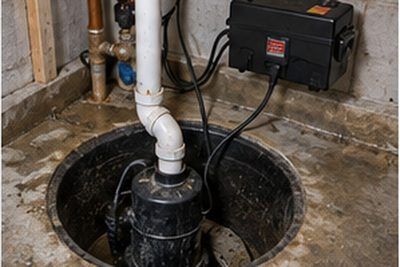
- The pit. Sized and sited at the low point, with a proper liner. A pit that is too small makes the pump short-cycle and shortens its life.
- The primary pump. Submersible in most installations, sized to the volume it realistically has to move rather than to whatever was there before.
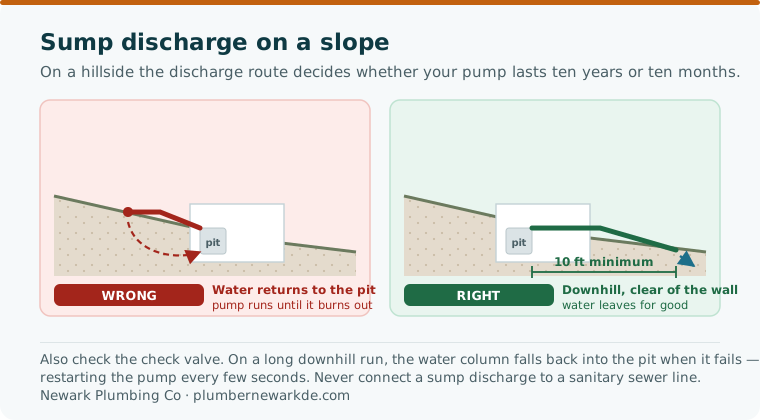
- The check valve. Stops the column of water in the discharge pipe falling back into the pit when the pump shuts off. A failed check valve is the usual cause of a pump that cycles endlessly for no reason.
- The discharge line. Routed well clear of the foundation, sloped away, and — in this climate — arranged so it cannot freeze solid and dead-head the pump in January.
- The backup. Battery or water-powered, running when the mains does not.
- An alarm. Inexpensive, and it tells you the pump has failed while the water is still in the pit rather than on the floor.
The freeze problem nobody designs for
Here is a local failure mode that catches people out. A discharge line that runs along the ground and terminates in the open can freeze at the outlet during a cold snap. The pump then starts, finds no way out, and runs against a solid plug — burning itself out, or tripping its breaker and leaving you with no pump at all.
Northern Delaware makes this worse than a colder climate would, because our winters cycle rather than staying frozen. Meltwater enters the line during a thaw, then refreezes overnight. A discharge arrangement that survives a Minnesota winter can fail in a Newark February.
The fixes are unglamorous: adequate slope so the line drains fully between cycles, a larger diameter at the outlet, and a freeze-relief fitting that gives water somewhere to go if the end does block. We specify these as standard here because we have seen the alternative.
Signs your existing pump is in trouble
- Running constantly in dry weather. Usually a failed check valve or a float set wrong.
- Grinding, rattling or screeching. Impeller or bearing damage. Time is short.
- Visible rust on the body, or a motor that runs hot to the touch.
- Vibrating hard in the pit. Often means the impeller is damaged or the pump has shifted off its base.
- Over about seven years old, with no idea when it was last tested.
- Standing water around the pit after a storm the system should have handled.
Test it before the next storm, not during
Pour a bucket of water slowly into the pit and watch the whole cycle. The float should lift, the pump should start promptly, clear the water, and stop cleanly without chattering on and off. Listen at the discharge outside to confirm water is actually leaving. Three minutes, twice a year.
What we do on an installation
We start by working out where the water is coming from, because sometimes a pump is not the right answer. Water entering through one wall after heavy rain may be a gutter discharging against the foundation or grading that slopes toward the house — both cheaper to fix than to pump. We would rather tell you that than sell you equipment.
Where a pump is the answer: pit assessed or installed, pump sized to the actual volume and head height, new check valve, discharge routed properly and clear of the foundation, backup and alarm where specified, and the whole thing tested under load before we leave. You get shown how to test it yourself.
Typical ranges: $600 to $1,500 for a primary pump replacement, $1,200 to $2,800 with battery backup. Full detail on the pricing page.
If your basement water arrives alongside slow drains or a gurgling floor drain, the cause may be a failing sewer lateral rather than groundwater — a different problem with a different fix. Properties around Pike Creek and Hockessin see the slope-driven version of this most often.
Sump Pump Installation & Repair in Newark — common questions
There is no correct number — it depends entirely on your water table, recent rainfall and how much drainage feeds the pit. Cycling every few minutes during heavy rain is normal. Cycling every few minutes in dry weather is not, and usually means the check valve is failing and letting water fall back into the pit, or the float is set too low.
What matters more than frequency is that it runs when it needs to. Test it every few months by pouring a bucket of water into the pit and watching the full cycle: pump starts, water clears, pump stops cleanly.
In this area, yes, and the reasoning is uncomfortable but simple: the storms that flood basements are the same storms that bring the power down. A mains-powered pump is offline at precisely the moment you need it most.
A battery backup runs the pump through an outage for several hours, which covers most of what northern Delaware produces. It roughly doubles the installed cost — $600 to $1,500 becomes $1,200 to $2,800 — and it is the single most worthwhile upgrade in this category.
Seven to ten years for a good quality unit, less if it runs frequently or is undersized for its workload. They rarely give warning. A pump that worked last month can fail silently, and you generally discover it during the storm.
Because of that, age alone is a reasonable basis for replacement. If yours is approaching ten years, replacing it on a dry Tuesday costs far less than discovering its condition at 2am with water rising.
Far enough from the foundation that the water does not simply drain back to the pit — generally at least ten feet, onto ground that slopes away. The most common installation fault we find is a discharge that terminates too close to the house, creating a loop where the pump keeps recycling the same water.
Do not connect a sump discharge to a sanitary sewer line. It is prohibited in most jurisdictions, it overloads the treatment system during storms, and it can push sewage back toward the house. Check local requirements before routing to a storm drain as well.
What to Expect
How a service call actually goes
No mystery and no vague promise to take a look. Here is the sequence from the moment you dial.
-
You call and describe the problem
A person picks up and asks practical questions — where the water is, whether it is still running, whether you have found the shutoff. If it is an emergency, we walk you through isolating it before we are anywhere near your street.
-
We give you an arrival window
A real window, not sometime today. You get a call before we head over. If the schedule slips, you hear it from us instead of wondering.
-
Diagnosis first, price second, work third
We find the actual cause before quoting. You get the price for the repair in front of you, and what it covers, before any work starts. If the honest answer is that a repair will not hold and you need a replacement, we say so and explain why.
-
We finish, test, and clean up
The repair gets tested under real conditions before we pack up — pressure restored, drains run, no weeping joints. Drop cloths down, debris out, and a plain-language explanation of what failed and what to watch for.
That sequence is the whole of our method, and how we work and price jobs explains the reasoning behind it — including the jobs we will talk you out of.