
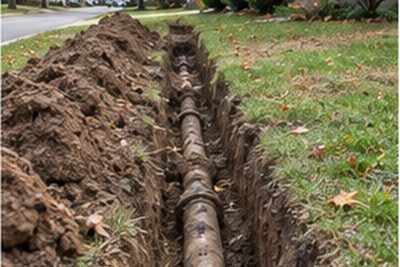
Three buried pipes, and people confuse them constantly
Every house in Newark has three separate buried runs, and conflating them is the most common reason someone gets quoted for the wrong job.
| Pipe | Carries | Runs from | Typical failure |
|---|---|---|---|
| Water service line | Clean water in, under pressure | Street main to the building | Corrosion, pinholes, lead concern |
| Sewer lateral | Waste out, by gravity | Building to the street main | Roots, collapse, bellying |
| Interior supply | Water to each fixture | Inside walls and floors | Galvanized corrosion → repiping |
This page is only about the first one. If waste is backing up rather than water failing to arrive, you want sewer line repair instead.
What Newark service lines are made of
Material tracks the decade the connection was made, not necessarily the age of the house — plenty of properties have had a service line replaced at some point while the interior plumbing stayed original.
- Lead, in the oldest connections. Standard material in American cities well into the twentieth century, so pre-1940 construction is the window. Most relevant in Wilmington and the oldest parts of Newark.
- Galvanized steel, through the mid-century. Same story as the interior pipe of that era: rust grows inward, the bore narrows, and pressure falls off long before anything leaks.
- Copper, from roughly the 1950s onward. Generally durable. Where it fails it is usually pinholing from aggressive soil conditions rather than age alone.
- HDPE and PEX, in modern work. Flexible, jointless along the run, and what we install in almost every replacement.
The test worth doing today
Scratch and magnet, thirty seconds
- Find where the water line enters, usually the basement wall facing the street, on the street side of the meter.
- Scratch it with a coin. Lead goes bright silver and is noticeably soft. Galvanized steel stays dull grey.
- Hold a magnet to it. Lead is not magnetic. Galvanized steel grips firmly. Copper does neither and is obvious by colour.
Bright silver scratch and no magnetic grip: treat it as lead and contact your water supplier. Utilities maintain service line inventories and many operate replacement programmes. Do not sand, file or disturb a suspected lead line.
How a service line announces itself
Unlike a sewer lateral, which fails dramatically, a service line usually declines quietly until someone connects the symptoms.
- Pressure that is low everywhere, equally on hot and cold, and has been getting worse for years. Interior corrosion usually hits the hot side harder; a service line problem does not discriminate.
- A wet or unusually green strip of lawn running in a line from the street toward the house, especially in dry weather.
- The meter moving with everything off. Shut every fixture, note the reading, wait two hours. Movement means water is escaping somewhere, and if the interior checks out, the buried line is next.
- A sudden jump in the water bill with no change in habits.
- Sediment or discoloured water on first draw that clears after running, on a house whose interior pipe is known to be copper.
Boring versus trenching, and why it decides the price
The pipe itself is a small part of what you pay. What matters is what sits on top of the route.
Directional boring pulls a new line through the ground along the existing route using small access pits at each end. Lawn, driveway and pavement stay largely intact. This is the preferred method wherever the ground allows it.
Open-cut trenching excavates the full length. Necessary where the old line has collapsed, where the route changes direction sharply, or where obstructions rule out boring. It also means reinstating whatever was on top.
Either way, the line must sit below the New Castle County design frost depth of 32 inches — in practice 42 to 48 inches — which is why a Newark service line essentially never freezes. If you have a freeze problem it is an exposed run inside the building, covered on our emergency page.
Permits, and work in the street
Service line replacement requires a plumbing permit, and inspection is carried out by a State of Delaware Plumbing Inspector rather than a city inspector. Where the work enters the public right of way, the municipality or county adds its own requirements for excavation, traffic control and surface reinstatement.
Your water supplier also has to be involved for the connection itself and for the meter. All of that is real time in the schedule, and it belongs in the quote honestly rather than appearing as a surprise. Across the line in Elkton and Cecil County, the permit authority and the code are Maryland's instead.
What it costs
Typically $2,500 to $8,000, and the spread is almost entirely about access rather than the pipe:
- Length of the run. A short line to a house set close to the street is a different job from a long approach up a drive.
- Boring or trenching. The single biggest variable.
- What is on top. Lawn is cheap to reinstate. A block-paved driveway or a city pavement is not.
- Depth and ground conditions. North of Newark the Piedmont brings shallower soil over rock; south and east the Coastal Plain is easier digging.
- Whether the street is involved, which adds permits, traffic control and restoration.
Full ranges for everything else are on the pricing page. As with every job here, we diagnose before quoting — on a buried line that means locating it and establishing the material and route first, not guessing from the driveway.
Water Service Line Replacement in Newark — common questions
They are different pipes doing different jobs. Repiping replaces the supply pipes inside your walls — the runs feeding each fixture. The service line is the single buried pipe carrying water from the public main in the street, under your garden, to the point where it enters the building.
They fail independently. You can have perfect interior copper fed by a corroded galvanized service line, or a new service line feeding sixty-year-old steel inside the walls. If pressure is poor everywhere and equally on hot and cold, the service line is worth checking before assuming the interior pipe is the problem.
Find where the water line enters the building, usually at the basement wall on the street side of the meter. Scratch it with a coin. Lead scratches to bright silver and is soft. Then hold a magnet to it — lead is not magnetic, while galvanized steel grips firmly. Copper is unmistakable.
Bright silver scratch plus no magnetic grip means treat it as lead until proven otherwise and contact your water supplier. Utilities are required to maintain service line inventories and many run replacement programmes, sometimes covering the public portion or assisting with the private side. This is worth pursuing rather than living with.
Responsibility usually splits at the curb stop — the small valve under a metal lid near the property boundary. The utility maintains the main and generally the portion up to that valve; the property owner maintains everything from there into the building.
That boundary does vary between the City of Newark, Artesian, Veolia and the other suppliers across our service area, so confirm it for your specific address rather than assuming. Where lead is involved, ask specifically about any replacement programme — the answer is often better than people expect.
Often, yes. Directional boring pulls a new line along the existing route through small access pits at each end rather than trenching the whole run. That matters enormously when the line passes under a driveway, a mature tree or a pavement.
It is not universal. A collapsed line, a route with sharp changes of direction, or ground with obstructions may force an open cut. We establish which is viable before quoting, because the difference between boring and trenching is most of the price.
What to Expect
How a service call actually goes
No mystery and no vague promise to take a look. Here is the sequence from the moment you dial.
-
You call and describe the problem
A person picks up and asks practical questions — where the water is, whether it is still running, whether you have found the shutoff. If it is an emergency, we walk you through isolating it before we are anywhere near your street.
-
We give you an arrival window
A real window, not sometime today. You get a call before we head over. If the schedule slips, you hear it from us instead of wondering.
-
Diagnosis first, price second, work third
We find the actual cause before quoting. You get the price for the repair in front of you, and what it covers, before any work starts. If the honest answer is that a repair will not hold and you need a replacement, we say so and explain why.
-
We finish, test, and clean up
The repair gets tested under real conditions before we pack up — pressure restored, drains run, no weeping joints. Drop cloths down, debris out, and a plain-language explanation of what failed and what to watch for.
That sequence is the whole of our method, and how we work and price jobs explains the reasoning behind it — including the jobs we will talk you out of.