
The one rule: look before you quote
Sewer work is the most expensive plumbing a homeowner ever buys. A full lateral replacement in this area runs five figures. Because of that, it attracts the worst behaviour in the trade — quotes issued from the driveway, "your line is collapsed" delivered without a camera, and scare-selling of a full replacement where a spot repair would have done.
We will not give you a sewer number before we have seen inside the pipe. Not because we are cautious, but because any number given without a camera is invented, and invented numbers only ever move in one direction.
What is actually under Newark streets
Newark's older neighbourhoods were laid out long before PVC existed, and the laterals reflect their era.
- Vitrified clay in the oldest runs. Durable material, but installed in short sections with a joint every few feet. Roots find those joints, and clay is brittle when ground shifts.
- Cast iron through the mid-century. Strong initially, then corrodes from the inside. The bottom of the pipe — the invert, permanently wet — goes first, so a line can look sound from above while the floor of it has rotted away.
- Orangeburg in some post-war construction. Bituminised wood fibre, essentially tar-impregnated paper. It deforms into an oval under load and fails completely. If you have it, you are replacing it.
- PVC in anything modern. Rarely the material at fault. When newer lines fail it is usually bedding — a section that was not properly supported and has settled into a belly that holds waste.
Layer on the local ground. Newark straddles the Piedmont–Coastal Plain boundary, so a lateral north of town may run through shallow soil over rock while one south of town sits in deeper sediment. Different settlement behaviour, different failure pattern, over a distance of a few miles.
How we diagnose
Before any of this, it is worth ruling out the cheap explanations. A sewer smell confined to one room is usually a dried-out trap rather than anything buried — why your drains smell separates the fixture-level causes from the ones that point at the main. What follows is for when the symptoms are across the house.
- Clear enough line to see. A camera cannot read through standing sewage. Sometimes cabling comes first purely to get a usable survey.
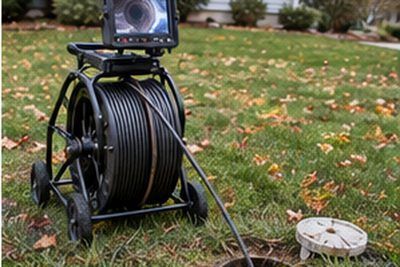
- Run the camera the full length. Not five feet past the cleanout. We record it, and you watch it with us.
- Locate the fault above ground. A sonde in the camera head lets us mark the exact position and depth on the surface. This is what turns "somewhere in the front garden" into a two-foot square, and it is the difference between a tidy excavation and a destroyed lawn.
- Grade the whole run, not just the fault. A spot repair on a pipe that is failing along its length is money wasted. You should know whether you are fixing one problem or the first of five.
You should see the footage
Ask for the recording. Any company doing this properly will hand it over without hesitation, and it is yours — useful for a second opinion, for an insurance claim, and for a buyer if you sell. Reluctance to share camera footage tells you what you need to know.
Repair options, cheapest first
- Root cutting and maintenance — for an otherwise sound clay line with intrusion at joints. Buys time rather than solving it, and roots return. Legitimate when replacement is not affordable this year.
- Spot repair — excavate and replace the failed section only, $1,500 to $4,000. Correct when the camera shows one bad joint or one crushed length and sound pipe either side.
- Trenchless lining or bursting — rehabilitate the full run through access pits. The right answer when the line runs under a driveway, mature trees or a street.
- Full open-cut replacement — $5,000 to $15,000. Necessary for collapse, severe bellying or Orangeburg. The wide band is real: a short run under lawn is a fundamentally different job from a long run under a road with traffic control and restoration.
Permits, and why they are not optional here
Sewer lateral work in Newark requires a permit, and inspection is carried out by a State of Delaware Plumbing Inspector. Work in the public right of way brings the municipality or county in as well, with its own requirements for excavation, traffic control and surface restoration.
This is real time in the schedule and it belongs in the quote honestly rather than appearing as a surprise. It is also why the cheapest sewer quote deserves a question: unpermitted sewer work is discovered when you sell the house, and by then the company that did it may well not exist.
If your problem is a repeating blockage rather than a structural failure, start with drain and main line clearing. If sewage is coming back into the house right now, that is an emergency — call rather than read.
Sewer Line Repair & Replacement in Newark — common questions
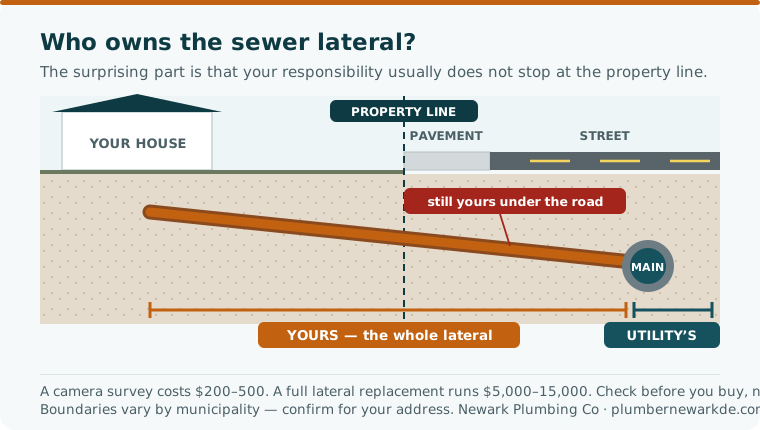
As a general rule in this area, the property owner owns and maintains the lateral — the pipe running from the house to the public main — including the portion under the sidewalk and street. The utility maintains the main itself. That means a collapse under the road is very often still the homeowner's bill, which is exactly why it is worth knowing the condition of your lateral before it fails.
Responsibility boundaries do vary between the City of Newark, New Castle County and the individual municipalities we serve. Confirm your specific address with your service provider before assuming either way, and check whether your insurance carries a service line endorsement.
The classic pattern is a main line that backs up on a roughly seasonal cycle, clears when cabled, then returns. Roots enter at joints, and older Newark laterals built from clay sections have a joint every few feet — an open invitation.
Other signals: gurgling from a toilet when the washing machine drains, more than one fixture slow at once, and unusually lush patches of lawn along the run of the pipe. A camera confirms it in minutes.
Trenchless methods — pipe lining and pipe bursting — rehabilitate or replace a lateral without excavating its full length. Lining cures a new pipe inside the old one; bursting fractures the old pipe outward while pulling a new one through. Both need only access pits at each end, which matters enormously when the alternative is trenching a driveway or a city street.
They are not universal. A fully collapsed line, a severely bellied section, or a lateral with sharp offsets may not be a candidate, and lining slightly reduces internal diameter. A camera survey determines whether it is viable for your run — which is another reason the inspection comes first.
Yes, on anything built before roughly 1970, and it is the single highest-value inspection you can add. A standard home inspection does not include a sewer camera survey — the inspector looks at fixtures, not at eighty feet of buried lateral.
The arithmetic is straightforward. A camera survey runs $200 to $500. A full lateral replacement runs $5,000 to $15,000. Finding out during negotiation is a price adjustment; finding out afterwards is a five-figure surprise on a house you have just spent your savings on.
What to Expect
How a service call actually goes
No mystery and no vague promise to take a look. Here is the sequence from the moment you dial.
-
You call and describe the problem
A person picks up and asks practical questions — where the water is, whether it is still running, whether you have found the shutoff. If it is an emergency, we walk you through isolating it before we are anywhere near your street.
-
We give you an arrival window
A real window, not sometime today. You get a call before we head over. If the schedule slips, you hear it from us instead of wondering.
-
Diagnosis first, price second, work third
We find the actual cause before quoting. You get the price for the repair in front of you, and what it covers, before any work starts. If the honest answer is that a repair will not hold and you need a replacement, we say so and explain why.
-
We finish, test, and clean up
The repair gets tested under real conditions before we pack up — pressure restored, drains run, no weeping joints. Drop cloths down, debris out, and a plain-language explanation of what failed and what to watch for.
That sequence is the whole of our method, and how we work and price jobs explains the reasoning behind it — including the jobs we will talk you out of.