
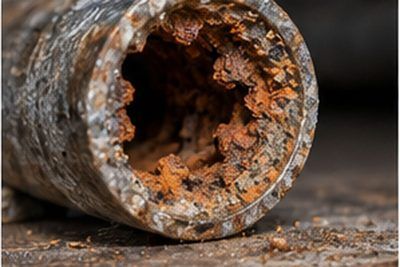
If your Newark house was built before about 1960 and has never been repiped, the supply pipe in your walls is probably galvanized steel. This post covers how to confirm that in thirty seconds, what is happening inside it, and how to tell where you are on the failure curve.
The thirty-second test
Go to the basement or crawl space and find an exposed supply pipe. Then:
- Look at it. Galvanized steel is dull silver-grey with threaded joints. Copper is unmistakably copper-coloured with soldered joints. PEX is flexible plastic, usually red, blue or white.
- Hold a fridge magnet to it. It grips galvanized steel firmly. It ignores copper and PEX entirely.
- Check the threads. Threaded connections with visible rust staining at the joint are a strong indicator.
Magnet grips, threads visible, house predates 1960 — you have original steel.
The catch that fools people
Many Newark homes have been partially repiped over the decades. Copper visible near the water heater does not mean the house is copper. Previous owners commonly replaced the accessible runs — the ones in the open basement — and left everything inside the walls alone.
So check more than one location, and check the runs that disappear into walls rather than the ones at eye level. The original steel usually survives exactly where it is hardest to reach, which is also where a leak does the most damage.
What is happening inside the pipe
Galvanized steel is ordinary steel with a protective zinc coating. The zinc is sacrificial: it corrodes instead of the steel beneath.
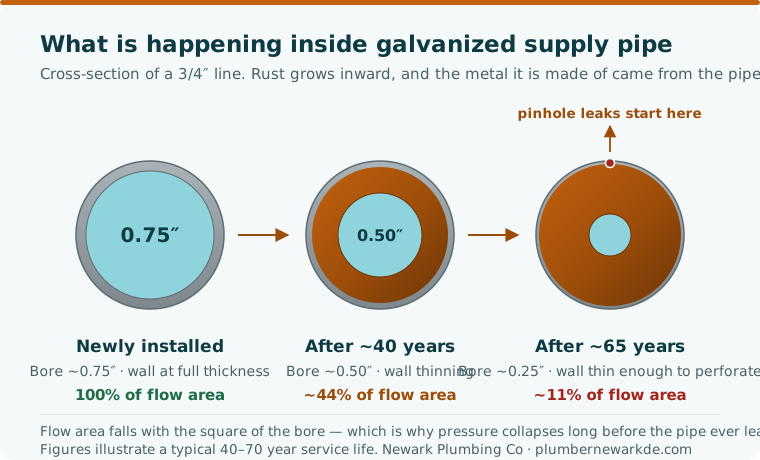
Water gradually strips it. Once the zinc is gone, the steel begins to rust — and because the water is inside, the rust grows inward.
A pipe that started with a three-quarter inch bore can end up with a quarter inch of usable space, choked with a rough, layered deposit. Two things follow from that:
- The bore shrinks, which is why pressure fails.
- The wall thins, because the iron in that rust came from the pipe itself. That is why pinholes appear.
Service life is typically 40 to 70 years. Essentially all of Newark's original galvanized steel is now past the end of it.
The symptoms, in the order they arrive
This progression is consistent enough to place your own system on it.
Stage 1 — pressure drops when a second tap opens
The first real symptom, and the most commonly ignored. The restricted bore cannot supply two fixtures at once. Run a tap, then open another and watch the first collapse.
People adapt to this without noticing. If your household has unspoken rules about not running the washing machine while someone showers, that is not a quirk — it is a diagnosis.
Stage 2 — hot side noticeably worse than cold
Heat accelerates corrosion, so hot runs degrade faster. A shower that is weak on hot but fine on cold points at the supply pipe rather than the water heater.
Stage 3 — rusty water after the house sits
Brown or orange water on first draw after a weekend away, clearing after a minute. Sediment has settled in the pipe and gets stirred up when flow resumes.
In Newark this produces a seasonal pattern in rental housing near the University. Properties stand empty over summer, water sits, and there is a reliable cluster of "the water is brown" calls every September from the same streets.
Stage 4 — the first pinhole leak
A small weep, often at or near a threaded joint where the wall is thinnest. Easy to repair, and frequently repaired without much thought.
Stage 5 — pinholes in clusters
This is the stage that matters. A second and third leak in different locations within a couple of years.
At that point you are no longer making repair decisions. The whole system has reached the same condition at the same time, because it was all installed at once and has corroded at the same rate. Patching becomes an ongoing expense with water damage attached.
The clustered-pinhole rule
Two pinhole leaks in different places within roughly two years means you are choosing between repiping on your schedule or repiping on the pipe's schedule. The second option costs more, because it includes whatever the water reached on the way down.
What you cannot do about it
You cannot clean it out. The rust narrowing the pipe is made of iron that came from the pipe wall. Removing it removes what is holding pressure.
You cannot patch your way out at stage 5. Each repair disturbs adjacent pipe. Working on badly corroded steel means fittings that shear rather than unthread, so the section next to the one you fixed frequently needs replacing too. That is not upselling; it is what sixty-year-old steel does when you touch it.
Partial repiping rarely helps on a house that is uniformly original. The remaining runs are the same age in the same condition, so you get a repeat within a few years — and you pay the access and restoration cost twice. If a plumber recommends doing half, ask what condition the other half is in and how they established it.
What repiping involves
The work itself is straightforward. The cost is in access.
New supply runs in PEX or copper from the main through to every fixture, with proper support, correct sizing, and new shutoff valves — which in a house this age are usually seized anyway. Rough-in inspection by a State of Delaware Plumbing Inspector happens while pipe is still exposed, so walls stay open until it passes. Then pressure test, flush, close up and patch.
Typical range in this area is $6,000 to $18,000, driven mostly by things that are not the pipe:
- Number of bathrooms and fixture groups
- Number of floors — vertical runs are harder than a basement ceiling
- Finished versus unfinished basement
- Plaster and lath versus drywall. Common in Newark's older housing, and considerably more work to open and restore.
- PEX versus copper
- How much restoration you want included
PEX is usually better value in an occupied older home, chiefly because its flexibility means fewer openings — and openings are the expensive part. Full detail on our repiping page, and the material choice itself in PEX or copper for a repipe — which also covers why PEX is not the grey polybutylene pipe people confuse it with.
Where geography helps
Not all older housing is equally expensive to repipe. A single-storey ranch — common in Glasgow and parts of the mid-century belt — has no vertical runs between floors and often an accessible basement ceiling. Those repipe comparatively cheaply.
A two- or three-storey row home in Wilmington with plaster walls and vertical stacks through finished floors is at the other end of the range.
The case for going first
Repiping a house that has not yet flooded is a planned project: your schedule, a price agreed in advance, furniture moved beforehand.
Repiping after a supply line lets go inside a wall is the same work plus water damage, plus drying, plus whatever the water reached — and an insurance process that may classify sixty years of corrosion as a maintenance failure rather than a sudden event.
If you are not sure where your system sits on the progression above, a pressure and leak assessment will tell you. And if you are buying an older Newark home, do the magnet test during the viewing, alongside a sewer camera survey.
The short version
Magnet grips the supply pipe, house predates 1960, never repiped — you are on original galvanized steel that is past its service life. Falling pressure comes first, rusty water later, pinholes last.
One pinhole is a repair. Two is a decision.
Related questions
No, and this is worth being clear about because the idea comes up often. The material narrowing the pipe is rust, and that rust is made of iron that came from the pipe wall itself. Removing it does not restore anything — it removes what is now the only thing holding pressure at that point.
Descaling methods exist for cast iron drain lines, where the pipe is not pressurised and the wall is much thicker. They are not applicable to pressurised galvanized supply pipe. If someone offers to clean out your supply lines, ask specifically what they intend to leave behind.
The rust itself is iron oxide and is not considered a health hazard, though it makes water taste metallic and stains fixtures and laundry. The more serious concern is that galvanized pipe of this era was coated using zinc that could contain lead impurities, and older systems frequently connected to lead service lines.
Corrosion can release accumulated deposits into the water. If your house predates 1960 and still runs original steel, testing is worthwhile — and check what your service line is made of where it enters the building.
Usually it covers the resulting water damage while excluding the pipe itself, and that distinction matters. Policies typically pay for sudden and accidental damage but exclude gradual deterioration — and corrosion over sixty years is the definition of gradual.
Some carriers go further, charging higher premiums or declining coverage on homes with original galvanized supply. If you are insuring a pre-1960 Newark home, ask the question directly rather than discovering the answer during a claim.