
Buying a house in Newark involves a fixed list of inspections that everyone does, and one that almost nobody does. The one nobody does is the one that can cost five figures.
What the standard inspection actually covers
A general home inspector performs a visual survey of accessible components. For plumbing, that means running taps, flushing toilets, checking under sinks for active leaks, looking at the water heater, and noting whether anything drains slowly.
All useful. None of it sees the sewer lateral — the buried pipe carrying everything out of the house to the public main, typically fifty to a hundred feet of it, under the garden and often under the pavement and street.
An inspector cannot assess that pipe by flushing a toilet. Water going down means the line is not completely blocked today. It says nothing about roots at a joint, a bellied section holding waste, scale narrowing the bore, or a cast iron invert that has rotted through.
So it goes uninspected, and ownership transfers at closing.
The arithmetic
| Cost | |
|---|---|
| Sewer camera inspection | $200 – $500 |
| Spot repair of one failed section | $1,500 – $4,000 |
| Full lateral replacement | $5,000 – $15,000 |
Discovering a problem before closing is a negotiation — a price reduction, a seller-funded repair, or a decision to walk away. Discovering it afterwards is a bill.
That asymmetry is the entire argument.
Which Newark houses genuinely need it
Not every property. Here is where I would and would not spend the money.
Get the inspection
- Anything built before about 1970. This is the main category, and most of Newark's older core qualifies.
- Any property with mature trees between the house and the street. Roots find joints.
- Any house where the seller mentions drains at all — even casually, even framed as resolved.
- Anything vacant for an extended period. Problems hide when nothing is running.
- Any property in Wilmington with pre-war construction. The oldest laterals in the region.
- Any house where a previous owner did unpermitted work. If corners were cut above ground, assume the same below it.
Probably skip it
- New construction under warranty in a development like Middletown, where the lateral is PVC installed with the house
- A property where the lateral was documented as replaced recently, with paperwork you can verify
Between those, use judgement. A 1995 house in Bear is lower risk than a 1935 house near Main Street, but "lower" is not "none" — newer laterals fail from poor bedding rather than from age.
What is under older Newark streets
The material tells you what to expect.
Vitrified clay in the oldest runs. Durable, but laid in short sections with a joint every few feet. Roots exploit those joints, and clay is brittle when ground shifts.
Cast iron through the mid-century. Strong initially, then corrodes from the inside. The bottom of the pipe — permanently wet — goes first, so a camera can show sound pipe at the top and no pipe at all at the bottom.
Orangeburg in some post-war construction. Bituminised wood fibre, essentially tar-impregnated paper. It deforms into an oval under load and eventually collapses. If the camera finds it, you are replacing it. There is no repair.
PVC in anything modern. Rarely the material at fault. When newer laterals fail it is bedding — a section that was not properly supported and has settled into a dip that holds waste.
Newark also straddles the Piedmont–Coastal Plain boundary, so ground conditions vary across the city. A lateral north of town runs through shallower soil over rock; one to the south sits in deeper sediment. Different settlement behaviour over a few miles.
What a proper survey looks like
Not all inspections are equal. Here is what you should be getting.
- The camera runs the full length, house to main connection — not five feet past the cleanout.
- You get the recording. Any company doing this properly hands it over without hesitation. It is yours: useful for a second opinion, for negotiation, and for your own records later.
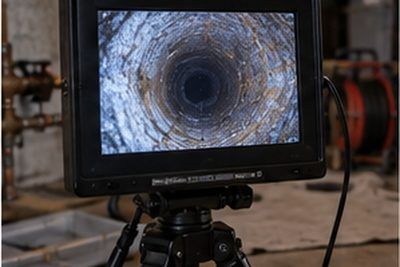
- Faults are located and marked above ground. A sonde in the camera head gives exact position and depth. This is what turns "somewhere in the front garden" into a two-foot square, and it is the difference between a tidy excavation and a destroyed lawn.
- The whole run is graded, not just the fault. You need to know whether you are looking at one bad joint or the first of five. A spot repair on a line failing along its length is money wasted.
- You get a written report you can hand to an agent, a seller or an insurer.
One practical note: a camera cannot read through standing sewage. If the line is holding water, it may need clearing before a usable survey is possible. That is normal, not an upsell — but it should be explained rather than simply added.
Using the result
Camera shows sound pipe. Good. You have removed the largest unknown on the property and you have a baseline recording for the future.
Camera shows roots at joints. Common in older clay, and not automatically a crisis. Ask what proportion of the run is affected and whether the pipe is otherwise intact. Root cutting is maintenance; a full replacement may be years away.
Camera shows a belly, a crack or an offset. Now you have a specific defect with a specific cost, before closing, with a seller who would prefer the sale to proceed. That is exactly where you want to be.
Camera shows Orangeburg or a collapse. Serious, and it reprices the house. Better to know.
Do the supply side while you are at it
The lateral is the expensive unknown. The other one costs nothing to check.
Go to the basement, find an exposed supply pipe, and hold a fridge magnet against it. It grips galvanized steel and ignores copper and PEX. If it grips and the house predates 1960, you are looking at original steel that is past its service life, and whole-home repiping is somewhere in your future.
That is a thirty-second test that can inform a five-figure decision. Do it during the viewing.
The short version
A standard home inspection does not see the sewer lateral. On pre-1970 Newark housing, that is the single largest buried liability on the property, and a camera survey at $200 to $500 is the cheapest insurance available against a $5,000 to $15,000 replacement.
Get it before closing, when a problem is a negotiation. Afterwards it is just a bill.
Related questions
No. A general home inspection is a visual survey of accessible components. The inspector will run taps, flush toilets and note whether drains appear slow, but that tests the fixtures rather than the buried lateral. Nothing in a standard inspection sees inside the pipe between the house and the public main.
A sewer camera survey is a separate service, usually arranged separately and paid for separately. Some inspectors offer it as an add-on; many do not. If you want it, ask for it explicitly rather than assuming it is covered.
Generally $200 to $500 depending on access and the length of the run. It is one of the cheaper line items in a property purchase and the one with the largest asymmetry between what it costs and what it can find.
Set against a full lateral replacement at $5,000 to $15,000, the arithmetic is not close. Even finding nothing is worth the money, because you then know the condition of the most expensive buried component on the property.
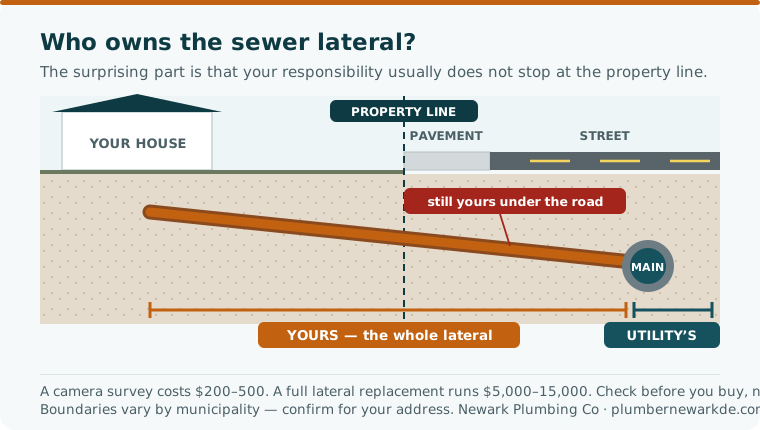
As a general rule in this area the property owner owns and maintains the lateral — the pipe from the house to the public main — including the portion running under the pavement and the street. The utility maintains the main itself.
That means a collapse under the road can still be the homeowner's bill. Responsibility boundaries do vary between the City of Newark, New Castle County and the individual municipalities in the region, so confirm for the specific address. It is also worth asking your insurer about a service line endorsement, which some policies offer as an add-on.