
Smell is information. A sewer odour indoors is not a hygiene failure or a sign of a dirty house — it means the seal separating your living space from the drainage system has been breached at a specific point, and finding that point is a short process of elimination.
Start with the barrier itself, because understanding it explains four of the five causes.
The thing that stops the smell
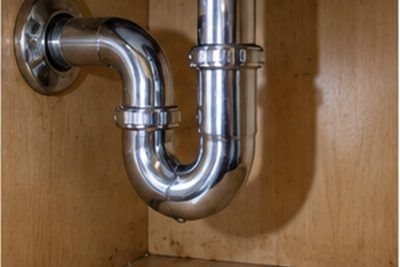
Look under any sink and you will find a U-shaped bend in the waste pipe. That is the P-trap, and it is the whole defence.
It holds a small volume of standing water permanently. Waste passes through it; sewer gas cannot, because gas will not push through a water seal. Every fixture in the building has one — basins, baths, showers, the washing machine standpipe, floor drains, and the toilet, whose trap is moulded into the porcelain.
If that water is not there, nothing separates the room from the drain. That is the most common cause by a wide margin, and it is free to fix.
The five causes, in order of likelihood
1. A dry trap
Trap water evaporates. In a fixture used daily it is replaced constantly and you never think about it. In a fixture used rarely, it disappears over a few weeks.
The usual suspects, and they are always the same:
- Basement floor drains. Nothing ever runs into them by design.
- The guest bathroom nobody has used since the last visitor.
- A second-floor shower in a household that uses the one downstairs.
- The utility sink in a garage or laundry.
- A disused washing machine standpipe after the machine moved.
The fix: run every fixture in the house for thirty seconds, and pour two or three litres of water slowly into any floor drain. Then wait a day.
For a fixture you genuinely never use
Refill the trap, then add a tablespoon of cooking oil. It floats on the water and dramatically slows evaporation — the standard trick for a basement floor drain or a second bathroom in an empty property. Some floor drains also have a trap primer, a small line that tops them up automatically; if yours has one and the trap still dries, the primer has failed.
2. Biofilm
A smell that is noticeable at the fixture rather than in the room generally, and often worse when the tap runs, is usually organic buildup rather than sewer gas.
Soap, skin cells, hair and grease coat the inside of the waste pipe and the tailpiece, and the bacterial film that grows on them smells. A basin's overflow channel is the classic hiding place: it is never touched by anything running down the plughole, so it accumulates for years.
In a kitchen the equivalent is the garbage disposal — under the splash guard and around the grinding chamber rim.
This one responds to cleaning rather than plumbing. A brush and hot water in the tailpiece and the overflow. Biological drain treatments work, slowly. Bleach does not — it passes straight through without dwelling where the film is, and it will not fix a dry trap at all.
3. A venting fault
This is the mechanically interesting one, and the one people misdiagnose.
Every drainage system needs air. When a bath empties, the column of water moving down the pipe has to be replaced by air, and that air comes through the vent stack running up through your roof.
If the vent is blocked — leaves, a bird's nest, ice in a cold snap, or a stack that was never correctly connected during a renovation — the draining water cannot get air from above, so it takes it through the nearest water seal instead, siphoning the trap dry as it goes.
Tell-tale signs:
- Gurgling from one fixture when another drains
- The smell appearing at the moment something empties
- A trap that dries out again within days of being refilled
- Bubbles rising in a toilet bowl when the washing machine discharges
That last one is worth taking seriously for a different reason: it can also indicate the main line. Which brings us to the two causes that are not a maintenance job.
4. A failed toilet seal
A smell around a toilet base, particularly one that is stronger low down or noticeable on the floor below, usually means the wax seal between the toilet and the closet flange has failed.
It almost always comes with a second symptom: the toilet rocks. Movement breaks the wax, the seal opens, and sewer gas escapes at floor level — followed eventually by water into the subfloor.
In older Newark housing the underlying cause is often the flange rather than the wax: cast iron that has corroded away at the bolt slots, or a flange left below the finished floor after someone tiled over the original surface. Both are covered on the toilet repair page.
Do not shim a rocking toilet and leave it. The rocking is what breaks the seal.
5. The main line
When the smell is not confined to one fixture, stop looking at fixtures.
Signals that point past the traps altogether:
| Sign | What it suggests |
|---|---|
| Several drains smelling at once | The line they share |
| Gurgling across multiple fixtures | Pressure changes in the stack or main |
| Slow drainage throughout the house | Restriction in the main, not a local blockage |
| Smell outdoors, near the lateral run | A break or displaced joint |
| Damp or unusually green ground over the line | A leak from the lateral |
In pre-1970s Newark and Wilmington housing the common findings are cast iron that has corroded through along the bottom of the pipe — the invert, which sits permanently wet and goes first — or a joint pushed apart by roots.
A camera survey tells you which and exactly where, and it is the difference between a targeted repair and a trench across a garden. See sewer line repair and drain cleaning.
The diagnostic table
Where and when the smell shows up narrows this faster than anything else.
| What you notice | Most likely | First move |
|---|---|---|
| One rarely used room smells | Dry trap | Run the fixture, pour water in the floor drain |
| Smell at the basin, worse when running | Biofilm in the tailpiece or overflow | Clean it mechanically |
| Smell when another fixture drains | Venting | Note which fixtures, then get it looked at |
| Gurgling plus smell | Venting, or the main line | Camera survey if more than one fixture |
| Smell at the base of a toilet | Wax seal or flange | Check whether the toilet rocks |
| Several drains at once | Main line | Camera survey |
| Rotten eggs on hot water only | Water heater anode | Not a drain problem at all |
| Rotten eggs on hot and cold | The water supply itself | Test it — usually a well |
| Smell after heavy rain only | Main line, or a vent terminal | Worth investigating |
The empty-house version
This one is specific to Newark, and it arrives on the same schedule every year.
A student rental empties in May. Nothing runs in it until late August. Every trap in the building dries out — two bathrooms, a kitchen, a laundry standpipe and a basement floor drain — and the first person through the door in September walks into a house that smells of sewer and concludes something is badly wrong with the plumbing.
Usually nothing is. It is five dry traps, and twenty minutes of running water fixes all of them.
The same applies to any property left empty for a season. Before a vacant house is occupied again:
- Run every fixture for a minute, including the ones you will not use.
- Pour water into every floor drain, and oil on top if it will sit unused again.
- Flush every toilet twice.
- Run the washing machine on a short cycle to refill the standpipe trap.
If the smell survives all four, it was not the traps — go back to the table above.
Landlords will find the rest of the pre-tenancy list in the Newark rental permit guide.
Sewer gas is not the same as a gas leak
Sewer gas smells of sewage — unpleasant, unmistakable, and at genuine concentration not harmless. A natural gas leak smells of sulphur or rotten eggs, from the odourant added deliberately so you can detect it. If you smell that and it is not confined to hot water, leave the building and call the gas utility from outside. Do not switch anything on or off on the way out, and do not start hunting for a P-trap.
What does not work
Bleach down the drain. It does not dwell where biofilm grows, and against a dry trap it achieves nothing at all except making the room smell of bleach and sewage.
Drain fresheners and gel sticks. They mask. Every one of the five causes above is still there the following week.
Sealing a floor drain. People cover them with plastic and tape, which stops the smell and also stops the drain functioning as a drain — at exactly the moment a basement takes water, which is the one job it has.
Replacing a fixture because it smells. The fixture is almost never the problem.
In short
Check the traps first. A fixture nobody uses dries out in weeks, and running water into every drain in the house — including floor drains — resolves most sewer smells for free. Cooking oil on top of the water keeps a genuinely unused trap sealed for months.
If the smell is at one basin and worse when the tap runs, it is biofilm, and it wants cleaning rather than plumbing. If it arrives when another fixture drains, or comes with a gurgle, it is venting. If it is at the base of a toilet that rocks, it is the seal or the flange.
And if several drains smell at once, with gurgling and slow drainage, stop treating fixtures — that is the main line, and in older housing here it is usually corroded cast iron or roots at a joint. A camera finds it in an afternoon.
Related questions
Intermittent smells point at a trap that is emptying and refilling — which usually means either a fixture nobody uses, or a venting fault.
If the smell appears after the room has been unused for a week or two, the trap is drying out by evaporation. If it appears at the moment another fixture drains, or comes with a gurgle, the drain is pulling air through the trap because it cannot get it from the vent. Those are different problems with the same symptom, and the timing separates them.
If the cause is a dry trap, yes — immediately and completely. Run every unused fixture for thirty seconds and pour a couple of litres into any floor drain, then wait a day.
If the smell comes back within days, the trap is not simply evaporating. It is being siphoned or blown out by pressure changes in the stack, and that is a venting fault rather than a maintenance one. For a fixture you genuinely never use, a small amount of cooking oil on top of the refilled trap slows evaporation considerably.
That is the water heater, not the drain, and the distinction matters — a smell on hot water only is almost never a plumbing drainage issue.
The usual cause is a reaction between the magnesium sacrificial anode in the tank and sulphate-reducing bacteria in the water, producing hydrogen sulphide. It is more common on private wells than on treated city supply. Replacing the anode with an aluminium-zinc type usually resolves it. If the smell is on hot and cold, the source is the water itself rather than the heater.
When it is not confined to one fixture. Several drains smelling at once, gurgling when a washing machine or bath empties, slow drainage across the house, or a smell noticeable outside near where the lateral runs — that combination points at the main line rather than any individual trap.
In pre-1970s Newark housing the usual finding is cast iron that has corroded through along the bottom of the pipe, or a joint displaced by root intrusion. A camera survey identifies which, and where, without excavation.